
Tracking basics
How to track baby food allergies and intolerances
Reactions rarely announce themselves at the table. Here's a simple, repeatable way to log meals and symptoms so a pattern can't hide, and what to do once you see one.
Quick answer
To track baby food allergies, introduce one new food at a time, log every meal with its ingredients and the time, and note what happens over the next few hours and the next day: skin, vomiting, poop, sleep and mood. Look for symptoms that repeat after the same food rather than one-off bad days, keep common allergens in the diet once they're going well, and take the record to your pediatrician.
Most parents start tracking after a scare: a red face after the first bite of yogurt, a night of screaming that might have been the lentils, a diaper that looked wrong. The trouble is that memory is a terrible record-keeper. By the time you suspect a food, the meals that matter are a week behind you and mixed up with teething, colds and growth spurts.
A simple, consistent log fixes that. It doesn't need to be clinical or time-consuming. It needs to capture the same few things every time, so that a pattern has somewhere to show up.
Allergy or intolerance? Why the difference matters for tracking
Parents often use the two words interchangeably, but they behave differently, and that changes what you watch for.
| Food allergy | Food intolerance | |
|---|---|---|
| What's going on | The immune system reacts to a food protein | The gut struggles to digest a food; the immune system isn't involved |
| Typical signs | Hives, swelling, vomiting, coughing or wheezing; some types cause delayed tummy or skin symptoms | Gas, bloating, tummy pain, loose or unusual stools |
| Timing | Often within minutes to 2 hours; some reactions are delayed by hours or days | Usually a few hours after eating |
| How much it takes | Even a small amount can trigger it | Often depends on how much was eaten |
| Risk | Can occasionally be severe (anaphylaxis) | Uncomfortable, but not dangerous |
For tracking, the takeaway is simple: watch the first couple of hours closely, then keep an eye on the next diaper and the next night. Immediate reactions tend to be obvious. The delayed ones are where a log earns its keep.
What to log after every meal
Keep it to the same short list every time. Consistency beats detail.
- Date and time of the meal, so you can line it up with symptoms later.
- Every ingredient, including the hidden ones: the butter on the toast, the milk in the scrambled egg, the wheat in the pasta.
- New or familiar? A first taste deserves extra attention.
- How they took it: refused, picked at it, or loved it. Refusal isn't a symptom, but a food that's consistently refused is worth noticing.
- Anything you saw afterwards and roughly when: rash, swelling, vomiting, coughing, unusual fussiness.
- The next poop and the next sleep. These are the quiet signals that most often reveal a food that doesn't agree.
- Context: teething, a cold, a vaccination, starting daycare. These explain a lot of bad days that have nothing to do with food.
How long to watch after a new food
Most immediate allergic reactions start within minutes and up to about two hours after eating, which is one reason many parents offer new foods in the morning or early afternoon rather than right before bed. Delayed reactions are slower: some cow's milk allergy symptoms, for example, can take hours or even days to appear, and often show up as changes in poop, skin or sleep rather than anything dramatic.
So a practical rhythm looks like this: stay close for the first two hours, check the next diaper or two, and note how the following night went. If you're unsure how long after eating a reaction can happen, that page goes through the timings in more detail.
Introduce one new food at a time
If a brand-new food arrives alongside two other brand-new foods, you can't tell which one caused a reaction. That's the idea behind the "3-day rule": give each new food, especially a common allergen, its own few days before the next newcomer. Familiar foods can be mixed freely around it.
Mixed meals are fine once the individual ingredients are known. When you do serve one, log every ingredient anyway: if something goes wrong, the culprit will be in the list.
How to spot a real pattern (and ignore the noise)
A single rough night proves nothing. Babies have bad days for a hundred reasons. What you're looking for is repetition: the same kind of symptom, after the same food, on more than one occasion.
- Compare averages, not moments. A food served eight times that mostly lines up with good days is probably fine, even if one of those days was terrible.
- Watch for drift. A food that used to go well and is slowly scoring worse is worth paying attention to.
- Rule out the obvious. Check the context notes: was the bad week also a teething week?
- Narrow the field. If one ingredient keeps appearing in the meals before the bad days, that's your suspect to discuss with your pediatrician.
One bad night is noise. The same bad night after the same food, three times in a month, is a pattern.
When to get help straight away
Call your local emergency number (911 in the US, 999 in the UK, 000 in Australia) if your baby has trouble breathing, wheezing, swelling of the lips, tongue or face, widespread hives, repeated vomiting, or becomes pale, floppy or unusually drowsy after eating. Don't wait to log it. Contact your pediatrician the same day for milder reactions such as a few hives, a single vomit after a new food, or blood in the stool.
How to do it in AllerLog
AllerLog is built around exactly this routine, so the log takes seconds instead of a notebook.
- Log the mealTap +, pick the meal type and time, and add ingredients from 158 built-in foods (or create your own). Tap a star for How did they like it?
- Add sleep and poop scoresOpen the meal's Sleep & poop sheet and rate each from 1 to 5. Didn't notice yet? Skip it and fill it in later.
- Flag allergensOn any ingredient, switch on Mark as allergen. You'll get an allergen check-in an hour after every meal that contains it.
- Let check-ins do the rememberingAllerLog nudges you 3 hours after a brand-new ingredient to ask how it went. You can change both delays in Settings.
- Read the ingredient chartEach food's page shows times served, its average score and a 12-month chart built from the mood, sleep and poop scores of every meal it was in.
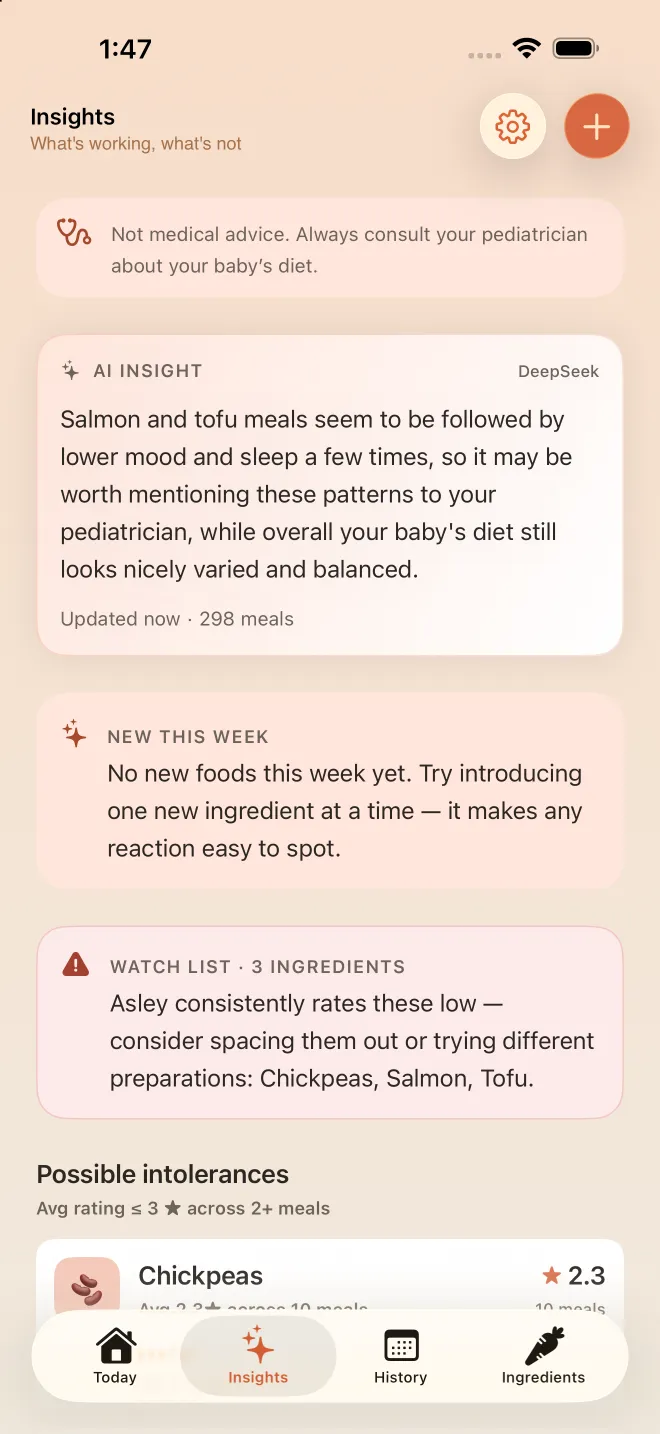
- Check InsightsWith Premium, Insights list possible intolerances (foods averaging 3 or less across 2+ meals) and a watch list, and optional AI Insights describe the pattern in plain words.
Bring the record to your pediatrician
The point of all this isn't to diagnose anything at home. It's to walk into the appointment with something better than "I think it might be dairy". With a log, you can show exactly which meals came before the symptoms, how often the food was served, and whether the pattern held. That's the information a doctor or allergist would otherwise have to reconstruct from memory, and it can make the next steps (an elimination trial, testing or a supervised challenge) faster and safer.
In AllerLog, open History to scroll back by day or month, and open the suspect ingredient to show its chart and every meal it was in.
Key takeaways
- Log the same few things after every meal: time, ingredients, how it went, and what happened after.
- Watch closely for two hours, then check the next poop and the next night.
- One new food at a time, especially for common allergens.
- Look for repetition, not one bad day, and rule out teething and illness.
- Severe symptoms are an emergency, not a data point.
Frequently asked questions
How long should I track before I can see a pattern?
Give it a few weeks, and at least two or three servings of any food you're unsure about. One bad night after a meal means very little; the same symptom after the same food, again and again, is a pattern worth raising with your pediatrician.
Should I stop giving a food that keeps scoring low?
Talk to your pediatrician before cutting anything out, especially common allergens like egg, peanut or dairy. Once a baby is eating an allergen without problems, keeping it in the diet regularly is part of how tolerance is maintained, so unnecessary avoidance can backfire. Stop a food straight away and get medical advice if it causes hives, swelling or vomiting.
Can an app diagnose a food allergy?
No. A tracker can show you that a food lines up with symptoms, but only a doctor or allergist can confirm an allergy or intolerance, usually with a careful history and sometimes with testing or a supervised food challenge. What a good log does is make that conversation much faster and clearer.
Sources & further reading
- Food allergy: symptoms and causes — NHS
- Food intolerance — NHS
- Food allergies in babies and young children — NHS
- Recognizing and treating reaction symptoms — Food Allergy Research & Education (FARE)
- Starting solid foods — American Academy of Pediatrics, HealthyChildren.org
AllerLog is a tracking and journaling tool that helps you and your pediatrician spot patterns. It is not a medical device and does not diagnose, treat or prevent any condition. This page is general information, not medical advice: always talk to a qualified healthcare professional about your child's diet, allergies and health. If your child has trouble breathing, swelling of the face or tongue, widespread hives, repeated vomiting or becomes floppy or pale after eating, call your local emergency number straight away.