Weaning (UK)
Weaning food diary: a free printable template and how to use it
Weaning is easier to enjoy when you're not trying to remember which day the egg went in. A simple diary, the NHS allergen list, and the signs worth a call to your GP or health visitor.
Quick answer
A weaning food diary is a simple record of what your baby eats and how they get on with it. For each meal, note the date and time, every ingredient, which foods are new, how much they ate, how they liked it, and how their sleep and next nappy went. It's most useful when you're introducing the foods that can cause allergies, which the NHS advises offering one at a time and in small amounts.
The NHS recommends starting solids at around 6 months, alongside breast milk or formula. In the first weeks it's mostly about getting used to new tastes and textures, and you'll introduce a long list of new foods in a fairly short time. A diary keeps track of all of it, so you're not trying to remember on Thursday whether the egg went in on Monday or Tuesday.
What to record in a weaning diary
- Date and time of each meal or snack.
- Every ingredient, including the ones hidden in a dish: butter, cheese sauce, the wheat in pasta.
- New foods, especially any of the allergens listed below.
- How much, roughly: "a few spoons", "half a finger of toast".
- How they liked it, from refused to loved it.
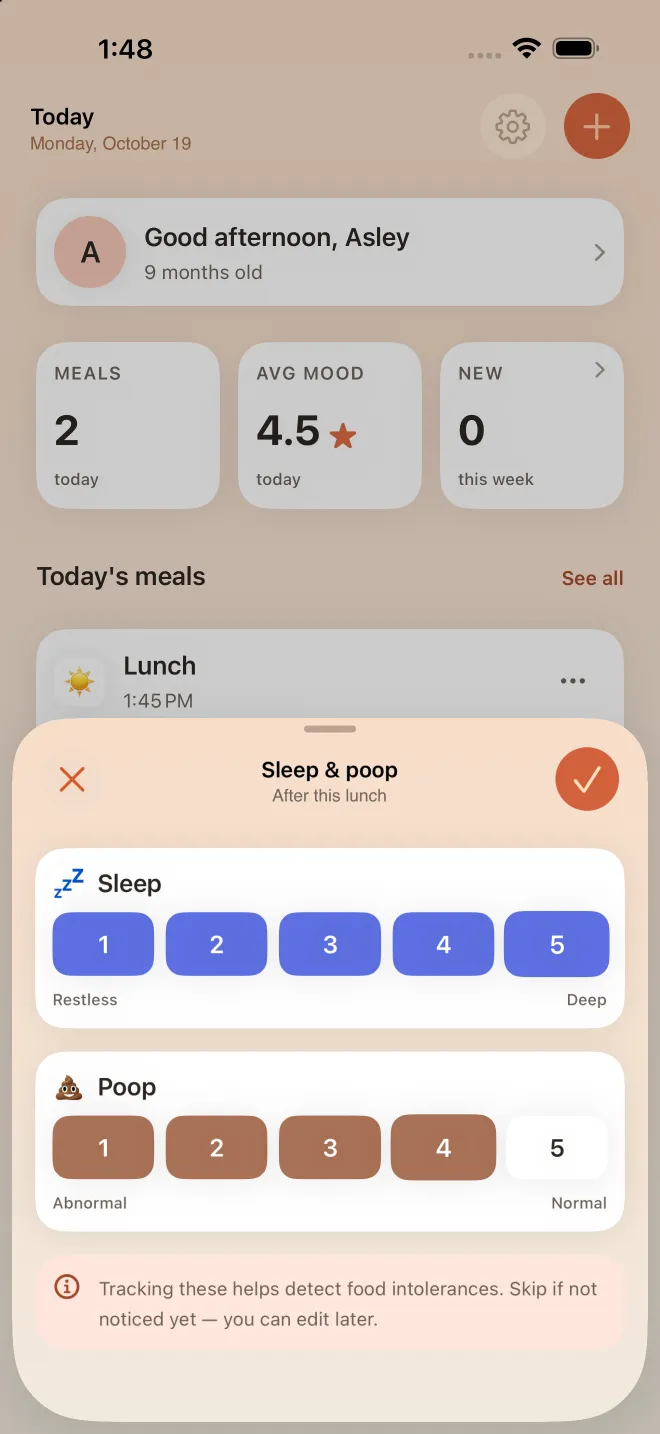
- Sleep afterwards and the next poo: tummy trouble often shows up here before anywhere else.
- Anything unusual: a rash, red cheeks, vomiting, a runny nose, plus context like teething or a cold.
The NHS allergen list to tick off
The NHS lists these foods as ones that can trigger allergic reactions. They can be introduced from around 6 months like any other food, but one at a time, so you can spot any reaction. Once each one is introduced and tolerated, the NHS advises keeping it as part of your baby's usual diet to minimise the risk of allergy, and notes that delaying peanut and hen's eggs beyond 6 to 12 months may increase the risk of an allergy to them.
| Allergen | Easy first ways to offer it | First tried | Still in diet? |
|---|---|---|---|
| Cows' milk | Full-fat yoghurt, or milk in cooking (not as a main drink before 12 months) | ||
| Eggs | Well-cooked scrambled egg or omelette strips (British Lion eggs can be served soft) | ||
| Gluten | Wheat toast fingers, pasta, couscous, barley or rye | ||
| Nuts & peanuts | Smooth peanut or nut butter thinned with water or milk, or finely ground nuts; never whole nuts | ||
| Seeds, especially sesame | Tahini stirred into purée or houmous; finely ground seeds | ||
| Soya | Tofu, soya yoghurt | ||
| Fish | Flaked salmon or cod, checked carefully for bones | ||
| Shellfish | Well-cooked prawns, finely chopped (never raw or lightly cooked) | ||
| Beans, lentils & peas | Mashed lentils, peas, houmous |
The NHS list also includes celery, mustard and sulphur dioxide (sometimes found in dried fruit and fruit juice). If your baby already has a diagnosed food allergy or eczema, or there's a family history of food allergies, eczema, asthma or hay fever, talk to your GP or health visitor before introducing these foods.
Printable weaning food diary
One row per meal. Leave a box blank if you didn't notice anything.
| Day & time | Foods & ingredients | New? | How much | Liked (1–5) | Sleep (1–5) | Poo (1–5) | Notes & reactions |
|---|---|---|---|---|---|---|---|
| Tue 9:00am | Porridge (oats, cows' milk), mashed pear | Milk ✓ | 6 spoons | 5 | 4 | 5 | All fine. Watched 2 hrs. |
Liked: 1 refused, 2 didn't like, 3 neutral, 4 liked it, 5 loved it. Sleep: 1 restless to 5 deep. Poo: 1 abnormal to 5 normal for your baby.
Spotting a reaction
Most reactions to a new food are mild, and many things that look worrying (red cheeks, a messy nappy, a bad night) turn out to be teething or a cold. What you're looking for is a symptom that keeps following the same food. According to the NHS, allergic reactions can cause:
- a red, itchy rash, or worsening eczema
- swollen lips or face
- red, itchy, watery eyes
- feeling or being sick, tummy pain, diarrhoea or constipation
- wheezing and coughing, sneezing, or a runny or blocked nose
The NHS says reactions usually happen within a few minutes of a new food, but can take up to 2 hours, and in some allergies, such as cows' milk allergy, up to 3 days. That's why the sleep and poo columns matter.
Call 999 straight away if…
your baby has breathing problems, a swollen throat or tongue, becomes pale and floppy, or collapses after eating. These can be signs of anaphylaxis, which is a medical emergency. For milder symptoms, stop the food and speak to your GP, health visitor or NHS 111 before offering it again. And don't be tempted to cut out a major food such as milk on your own: the NHS warns it could leave your baby short of nutrients.
Use AllerLog as your weaning tracker
AllerLog is the same diary on your iPhone, with the reminders a paper diary can't give you.
- Log each mealTap +, choose breakfast, lunch, dinner or a snack, and add ingredients from 158 built-in foods. Milk, egg, fish, peanut and tree nuts are already flagged as allergens.
- Rate itTap a star for How did they like it?, then add a sleep and poo score from 1 to 5 when you know how the nap and nappy went.
- Get a nudge after new foodsAllerLog checks in 3 hours after a first taste and 1 hour after a flagged allergen, so you remember to note how it went.
- See what's been triedIn Ingredients, the Allergens and Not tried filters show which allergens are in, and which foods are still to come.
- Bring it to the GPOpen any food to see how many times it's been served and a chart of how those meals went.
Frequently asked questions
When should I start weaning?
The NHS recommends starting solid foods at around 6 months, when your baby can stay in a sitting position and hold their head steady, coordinate their eyes, hands and mouth, and swallow food rather than pushing it back out. If you're thinking about starting earlier, speak to your health visitor or GP first.
Do I need to keep a weaning diary?
It isn't required, but it makes the allergen stage much easier. A diary tells you at a glance which foods have been introduced, how your baby got on, and whether any symptoms keep following the same food, which is exactly what a GP will ask if you're worried.
What is the best weaning app in the UK?
It depends on what you need. Recipe apps help with meal ideas; a tracker like AllerLog is built for the diary side: logging meals, rating how your baby liked them, scoring sleep and poo, and reminding you to check in after new foods and allergens.
Sources & further reading
- Weaning — NHS Best Start in Life
- Your baby's first solid foods — NHS
- Food allergies in babies and young children — NHS
- Foods to avoid giving babies and young children — NHS
- Anaphylaxis — NHS
AllerLog is a tracking and journaling tool that helps you and your pediatrician spot patterns. It is not a medical device and does not diagnose, treat or prevent any condition. This page is general information, not medical advice: always talk to a qualified healthcare professional about your child's diet, allergies and health. If your child has trouble breathing, swelling of the face or tongue, widespread hives, repeated vomiting or becomes floppy or pale after eating, call your local emergency number straight away.