Poop & digestion
Baby poop tracker for starting solids: link every diaper to the food before it
Most poop trackers are built for the newborn months: count the diapers, note the color. Once solids start, the more useful question is which food came before the change.
Quick answer
To track baby poop after starting solids, give each poop a quick score from 1 (clearly abnormal) to 5 (normal for your baby) and link it to the meal before it. Note anything specific, such as mucus, very loose or very hard stools, or a sore bottom. A poop that changes once is noise. The same change after the same food, more than once, is worth showing your pediatrician.
Once solids start, your baby's poop changes: thicker, darker, smellier, and suddenly full of surprises. Most of that is completely normal. But poop is also one of the clearest windows into how a food is agreeing with your baby, and often the first place a food intolerance or delayed allergy shows up.
The challenge is connecting a diaper on Wednesday afternoon to a meal on Wednesday morning, or was it Tuesday's dinner? That's what a solids-era poop tracker is for.
A simple 1–5 poop score
You don't need a stool chart with eight categories. A single score, compared with what's normal for your baby, captures what matters for spotting a pattern:
| Score | What it looks like |
|---|---|
| 5 | Normal for your baby: soft, formed or mushy, passed easily |
| 4 | Mostly normal, a little looser, firmer or smellier than usual |
| 3 | Noticeably off: runny, pellet-like, unusual mucus, some straining |
| 2 | Clearly unusual: watery, very hard and painful, lots of mucus, a sore red bottom |
| 1 | Abnormal, with symptoms: repeated diarrhea, blood, or an unhappy, uncomfortable baby |
The scale is yours to calibrate. If your baby always has very soft stools, that's their 5.
What's normal once solids start
- Thicker and smellier stools, more like an adult's as the diet expands.
- Color that follows the food: orange after carrots, green after spinach or peas, dark threads after banana.
- Bits of undigested food, such as peas, corn and tomato skins.
- Changes in frequency, as the gut adjusts to fiber.
Our article on baby poop after starting solids goes through the common changes food by food.
Changes worth noting
These aren't emergencies on their own, but they're the changes to score low and keep an eye on, especially if they keep coming back after the same food:
- Runny or watery stools, or many more stools than usual
- Mucus that keeps appearing
- Hard, pellet-like stools or straining and discomfort (constipation)
- A sore, red bottom that flares after particular meals
- Lots of gas and fussiness alongside the change
Call your pediatrician about…
blood in the stool, black or tarry stools (after the newborn period), white, gray or very pale stools, diarrhea with signs of dehydration (fewer wet diapers, a dry mouth, unusual sleepiness), or poop changes with vomiting, fever or weight loss. Repeated, forceful vomiting a few hours after a food needs urgent medical advice.
How long until a food shows up in poop?
Usually within a day or two, though it varies. That delay is why scoring the next poop or two after a meal works better than judging the poop that arrives straight after eating. More on how long food takes to show up in baby poop.
Track poop by meal in AllerLog
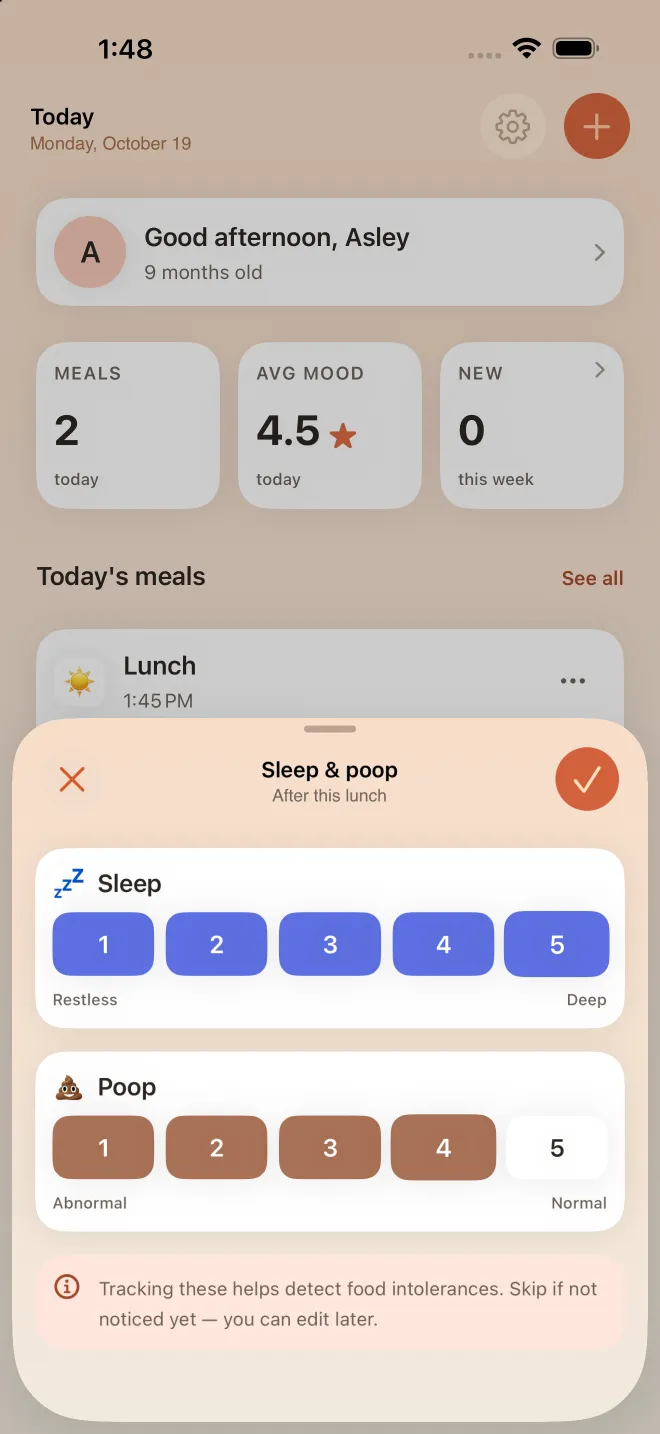
AllerLog's poop score is built around exactly this 1–5 scale, from abnormal to normal, and ties every score to the meal before it.
- Log the mealIngredients, time and how they liked it.
- Score the next poopOpen Sleep & poop from the meal card and tap 1 to 5. If the diaper hasn't happened yet, skip it and come back.
- Add details to notesMucus, color, a sore bottom: a word or two is enough.
- Watch the trendOn the Insights screen, Poop over time charts the score across the last 12 months, for free.
- Find the food behind itEach ingredient's chart includes the poop scores of the meals it was in, so a food that keeps lining up with low scores shows a falling line.
Frequently asked questions
How many times a day should a baby poop after starting solids?
It varies a lot. Some babies poop a few times a day; others go every couple of days. What matters most is what's normal for your baby, and whether stools are soft and passed without pain. A sudden, lasting change is worth mentioning to your pediatrician.
Is it normal to see undigested food in baby poop?
Yes. Pieces of foods like peas, corn, tomato skins, beans and raisins often pass through partly undigested while a baby's chewing and digestion are still developing.
Can a food change the color of my baby's poop?
Yes. Carrots and sweet potato can turn it orange, leafy greens can make it greener, and banana or blueberries can leave dark threads or specks. Red, black (after the newborn stage) or white, chalky poop should be checked by a doctor.
Sources & further reading
- Food allergies in babies and young children — NHS
- Food intolerance — NHS
- Starting solid foods — American Academy of Pediatrics, HealthyChildren.org
AllerLog is a tracking and journaling tool that helps you and your pediatrician spot patterns. It is not a medical device and does not diagnose, treat or prevent any condition. This page is general information, not medical advice: always talk to a qualified healthcare professional about your child's diet, allergies and health. If your child has trouble breathing, swelling of the face or tongue, widespread hives, repeated vomiting or becomes floppy or pale after eating, call your local emergency number straight away.