Baby-led weaning
Baby-led weaning tracker: how to track BLW foods and reactions
With baby-led weaning, half the food ends up on the floor and you're never quite sure what went in. Here's how to track BLW in a way that's still useful.
Quick answer
To track baby-led weaning, log what you offered (every ingredient), a quick note on how much was actually eaten versus explored, how your baby liked it, and what happened afterwards: any reaction, the next poop and the next sleep. Introduce common allergens one at a time in BLW-friendly forms, and keep a running list of first tastes so variety stays high.
Baby-led weaning (BLW) skips the spoon: your baby feeds themselves soft finger foods from the start. It's messy, it's fun, and it makes tracking a little different. With purées you know roughly how many spoonfuls went in. With BLW, a "meal" might be three licks of a broccoli floret and a strip of omelette thrown on the floor.
The good news is that a BLW log doesn't need to be precise. It needs to be consistent.
What makes BLW tracking different
- Offered isn't eaten. Log every food that was on the tray, then add a quick note on how much made it in: "explored", "a few bites", "ate most of it".
- Small amounts still count for allergens. Even a little egg or peanut is an exposure, so log it as one, and watch for a reaction just as you would after a spoonful.
- Mess can hide skin reactions. Food smeared on cheeks can cause redness by contact alone. Wipe your baby's face gently after meals so you can tell irritation from hives.
- Likes take time. A food mashed and dropped on day one might be eaten on day ten. Rate each attempt and keep offering.
What to log after a BLW meal
- Every food you offered, including the oil, butter or seasoning.
- Whether anything was new, and whether it's a common allergen.
- Roughly how much was eaten (a word or two is enough).
- How your baby took it, from refused to loved it.
- Any reaction and when it started.
- The next poop and the next sleep, once you know.
- Gagging notes if it helps you: which shapes or textures caused it.
Introducing allergens the BLW way
Allergens fit into BLW easily, as long as they're in a safe form. Introduce them one at a time, in a small amount, and stay close for a couple of hours.
| Allergen | BLW-friendly ideas |
|---|---|
| Egg | Strips of well-cooked omelette or egg muffin |
| Peanut | Smooth peanut butter thinned and spread thinly on toast fingers; never whole or chopped nuts |
| Dairy | Full-fat plain yogurt on a preloaded spoon; cheese grated into a finger food |
| Wheat | Toast fingers, soft pasta shapes, pancake strips |
| Fish | Soft flakes of salmon or cod, checked carefully for bones |
| Sesame | Tahini mixed into hummus and spread on toast |
| Soy | Soft tofu fingers |
If your baby has severe eczema or a known food allergy, talk to your pediatrician before introducing allergens, as they may recommend a different approach.
Gagging vs choking: what to note
Gagging is a normal, noisy reflex as babies learn to move food around: they may cough, splutter, go red and push the food forward. Choking is different: it's usually silent, and your baby can't cough, cry or breathe. Choking is an emergency. Call your local emergency number and start infant first aid immediately.
Taking an infant first-aid course before starting BLW is worth it. For tracking, noting which shapes caused a lot of gagging helps you adjust sizes and textures for the next meal.
Choking hazards to avoid
Whole nuts and peanuts, whole grapes, cherry tomatoes and blueberries (quarter or flatten them), popcorn, hard raw vegetables and apple, chunks of meat or cheese, and anything hard, round or sticky. Always serve food with your baby sitting upright and supervised.
Track BLW in AllerLog
AllerLog doesn't care whether the meal was spooned or self-fed: you log what was offered and how it went.
- Log the trayTap + and add every food you offered. If something isn't among the 158 built-in foods, add it with its own emoji.
- Note what was eatenUse the meal's notes: "explored only", "ate half", "loved the egg strips".
- Rate itA star for How did they like it?, then sleep and poop scores once you know.
- Flag allergensTurn on Mark as allergen for any food you're watching to get a check-in an hour after it's served.
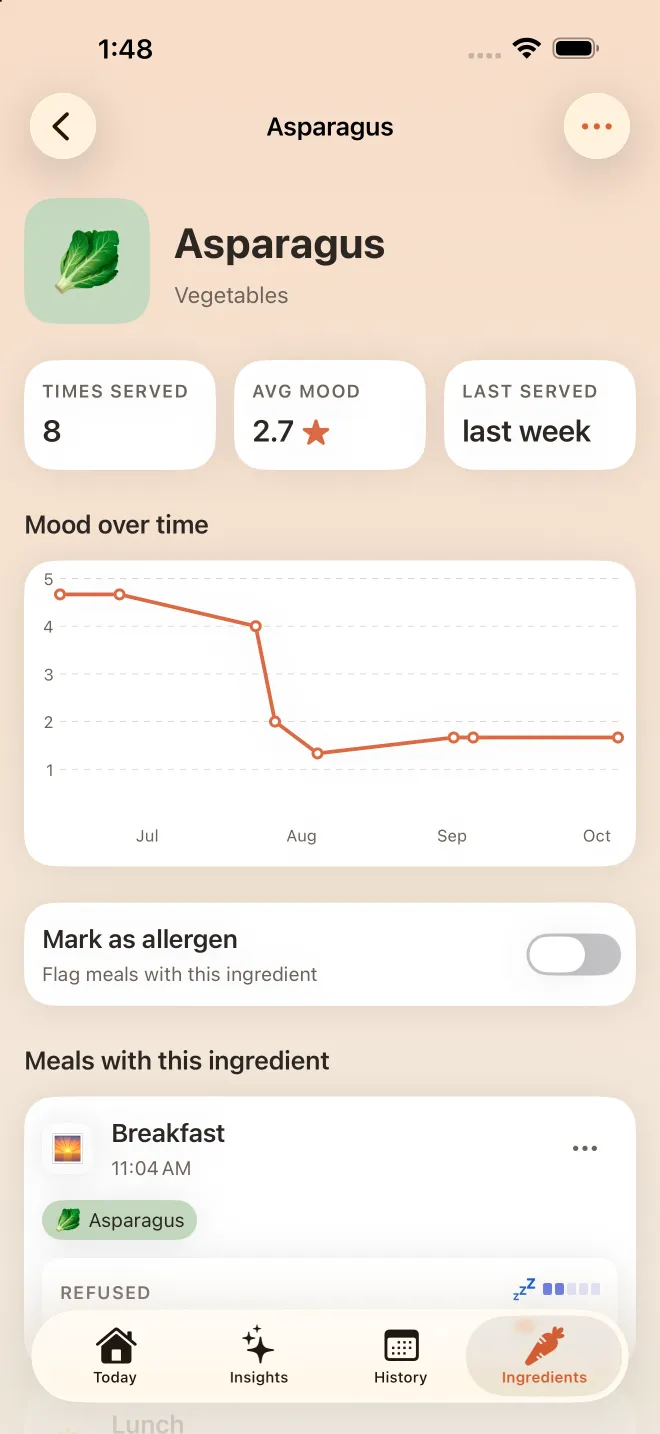
- Keep offering refused foodsThe ingredient page shows how often a food has been served and how it's trending, so a few "no"s don't become "never".
Frequently asked questions
Is baby-led weaning safe?
Baby-led weaning can be a safe way to start solids when foods are prepared in a safe size and texture, your baby is upright and supervised at every meal, and choking hazards are avoided. Ask your pediatrician if your baby was premature or has any feeding, developmental or medical concerns.
Can I combine purées and baby-led weaning?
Yes. Many families mix spoon-feeding and finger foods, sometimes in the same meal. Tracking works the same way either way: log the ingredients and how it went.
How do I know if my baby ate enough with BLW?
In the early months, breast milk or formula is still the main source of nutrition, and solids are about exploring. Your pediatrician will track growth. If you're worried about intake or weight, raise it at your next checkup.
Sources & further reading
- Starting solid foods — American Academy of Pediatrics, HealthyChildren.org
- Your baby's first solid foods — NHS
- Foods to avoid giving babies and young children — NHS
- Food allergies in babies and young children — NHS
AllerLog is a tracking and journaling tool that helps you and your pediatrician spot patterns. It is not a medical device and does not diagnose, treat or prevent any condition. This page is general information, not medical advice: always talk to a qualified healthcare professional about your child's diet, allergies and health. If your child has trouble breathing, swelling of the face or tongue, widespread hives, repeated vomiting or becomes floppy or pale after eating, call your local emergency number straight away.