Sleep
Can food affect baby sleep? Why nights can get worse after starting solids
You were promised solids would help them sleep. Instead, the nights got worse. Here's how food can disturb sleep, the other usual suspects at this age, and how to tell them apart.
Quick answer
Yes, food can affect a baby's sleep. Gas, constipation, reflux or a food that doesn't agree, including delayed allergies such as cow's milk allergy, can cause restless nights and extra wakings. But around 6 months, teething, new skills, illness and sleep regressions are more common causes. The clue that it's the food is bad nights that keep following the same food.
It's one of the great parenting myths that a tummy full of solids means a baby who sleeps through. For many families the first weeks of solids bring the opposite: more wakings, more fussing, earlier mornings. Sometimes food is part of the reason. Often it isn't. The trick is telling which.
How food can disturb sleep
- Gas and bloating. New fiber and carbohydrates mean more gas, which can make lying down uncomfortable. See why babies get gassy after starting solids.
- Constipation. Hard stools and straining are common in the first weeks of solids and can cause night-time discomfort.
- Reflux. Some babies with reflux are more uncomfortable after certain meals or when lying flat soon after eating.
- A food that doesn't agree. Food intolerances and delayed (non-IgE) allergies, such as cow's milk allergy, can cause tummy pain, loose stools and eczema itch, all of which tend to show up at night.
The non-food reasons sleep gets worse around 6 months
Before blaming the broccoli, consider what else is going on at this age:
- Teething, which often starts around the same time as solids
- New skills like rolling, sitting, crawling and pulling up, which babies love to practise at 2am
- Separation anxiety, which commonly emerges in the second half of the first year
- Illness, especially once a baby starts daycare
- Changing naps and daytime routines
Does starting solids help babies sleep?
Not in the way many parents hope. As the NHS puts it, starting solid foods will not make your baby any more likely to sleep through the night. In the large UK EAT trial, babies who started solids from 3 months slept slightly longer than those who waited, but the difference peaked at about 17 minutes a night at 6 months. That's not a reason to start before your pediatrician recommends, which for most babies is around 6 months. Putting cereal in a bottle isn't a fix either: the American Academy of Pediatrics advises against it because of the choking risk and the extra calories, unless your doctor recommends it for reflux.
How to tell whether it's the food
- Score sleep after meals, especially the evening meal, on a simple 1–5 scale from restless to deep.
- Note the other factors: teething, a cold, a big developmental week, a missed nap.
- Compare nights. After a couple of weeks, look at the nights that followed a suspect food versus the nights that didn't.
- Try moving new foods earlier in the day and see whether the bad nights move too.
- Talk to your pediatrician if the pattern holds, particularly if there are other symptoms like loose or bloody stools, vomiting, eczema or poor weight gain.
Track sleep against food in AllerLog
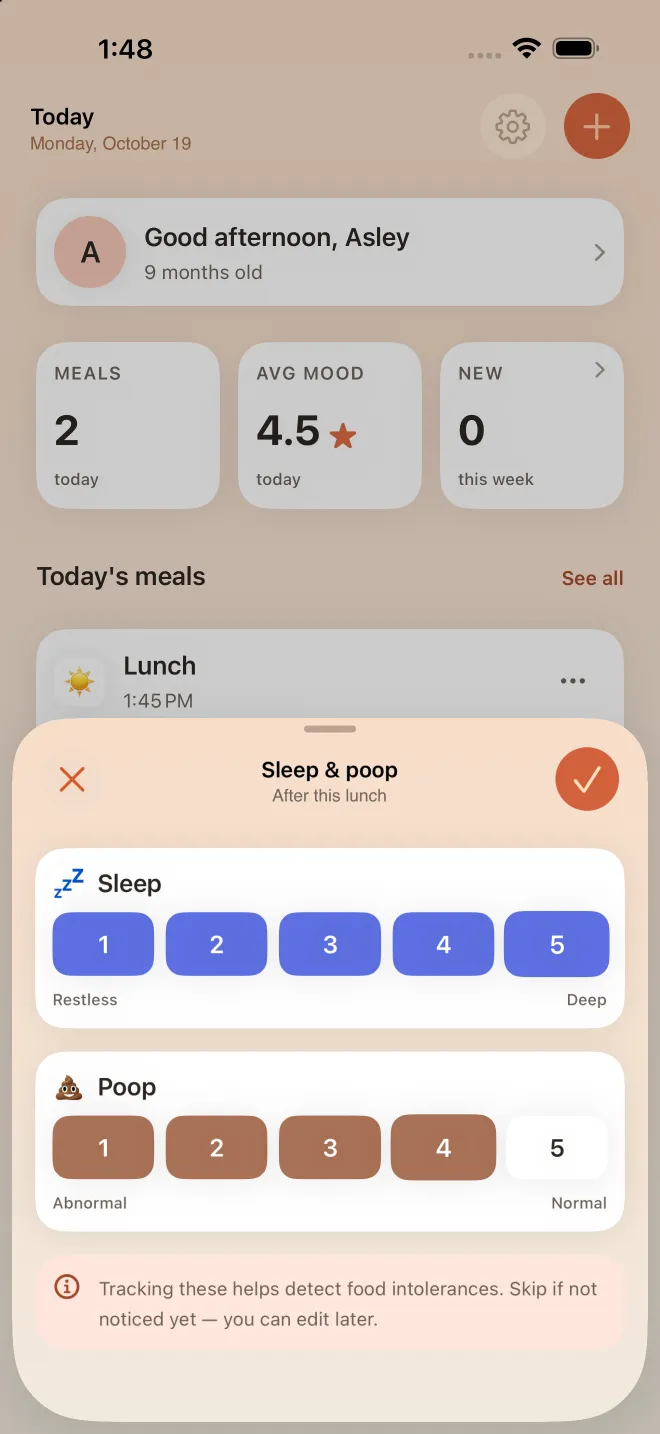
- Score sleep after each mealIn the meal's Sleep & poop sheet, rate sleep from 1 (restless) to 5 (deep). Fill it in the next morning if you need to.
- Note what else happened"Teething", "cold", "new daycare" in the meal's notes keeps the context with the data.
- Watch the sleep trendSleep over time on the Insights screen charts sleep scores across the last 12 months, for free.
- Check the suspect foodEach ingredient's chart includes the sleep scores of every meal it was in, so a food behind the bad nights shows a falling line.
Frequently asked questions
Should I avoid new foods at dinner?
Many parents introduce new foods, especially common allergens, earlier in the day. That way any reaction is more likely to happen while your baby is awake and you're watching, and a bad night is easier to judge.
Can teething and starting solids happen at the same time?
Often, yes. Both commonly start around 6 months, which is exactly why it's hard to tell what's behind a bad night. Note teething days in your log so you can separate the two.
Are there foods that help babies sleep?
There's no strong evidence that any particular food makes babies sleep better. A comfortable tummy, a predictable bedtime routine and enough daytime feeding tend to matter more than what's on the dinner menu.
Sources & further reading
- Food allergies in babies and young children — NHS
- Your baby's first solid foods — NHS
- Association of early introduction of solids with infant sleep (EAT study) — JAMA Pediatrics, 2018
- Food allergy: symptoms and types — NHS
- Starting solid foods — American Academy of Pediatrics, HealthyChildren.org
AllerLog is a tracking and journaling tool that helps you and your pediatrician spot patterns. It is not a medical device and does not diagnose, treat or prevent any condition. This page is general information, not medical advice: always talk to a qualified healthcare professional about your child's diet, allergies and health. If your child has trouble breathing, swelling of the face or tongue, widespread hives, repeated vomiting or becomes floppy or pale after eating, call your local emergency number straight away.