Templates
Baby food diary template: free printable and how to fill it in
Print it, stick it on the fridge, fill in one row per meal. Here's the template, what to write in each column, and how to read it once a few weeks are filled in.
Quick answer
A useful baby food diary records the same eight things for every meal: date and time, every ingredient, whether a food is new, roughly how much was eaten, how your baby liked it, how they slept afterwards, their next poop, and any reaction or note. Print the free template below, fill in one row per meal, and review it once a week for foods that keep lining up with bad days.
A food diary is the single most useful thing you can keep while your baby starts solids. It's also what doctors ask for: the NHS notes that if a food allergy is suspected, you may be asked to keep a food and symptoms diary to help work out the trigger. It turns "I think the lentils upset her" into something you can check, and it gives your pediatrician a clear history if a reaction ever needs investigating. It only works, though, if it's quick enough to fill in after every meal. That's why this template sticks to eight columns.
Free printable baby food diary
One row per meal. Use the 1–5 scales explained below, and leave a box blank if you didn't notice. The first row is an example.
| Date & time | Foods & ingredients | New? | How much | Liked it (1–5) | Sleep after (1–5) | Poop after (1–5) | Reactions & notes |
|---|---|---|---|---|---|---|---|
| Mon 8:10am | Scrambled egg, butter, toast fingers | Egg ✓ | 4 spoons | 4 | 5 | 5 | No reaction. Watched 2 hrs. |
Scales. Liked it: 1 refused, 2 didn't like, 3 neutral, 4 liked it, 5 loved it. Sleep: 1 restless to 5 deep. Poop: 1 abnormal to 5 normal for your baby.
Tip: print in landscape and print several copies. Choose "Save as PDF" in the print dialog to keep a digital copy.
What to write in each column
- Date and time. The time matters as much as the date: it's how you'll line up a 3pm rash with an 11am lunch.
- Foods and ingredients. List every ingredient, not just the dish. "Pasta bake" hides wheat, cheese, milk and possibly egg.
- New? Tick any food your baby is trying for the first time and name it. First tastes of common allergens deserve a closer watch.
- How much. A rough guide is enough: "2 spoons", "half a pancake", "mostly on the floor". It helps explain a no-reaction day after a tiny taste.
- Liked it (1–5). From 1 (refused) to 5 (loved it). Refusal isn't a reaction, but repeated refusal of one food is worth noticing.
- Sleep after (1–5). How the next nap or night went, from restless to deep. Tummy trouble often shows up here first.
- Poop after (1–5). The next poop, from clearly abnormal (watery, mucus, very hard) to normal for your baby. It's one of the best early clues.
- Reactions and notes. What you saw and when it started, plus context like teething, a cold or a vaccine.
A filled-in example week
Here's what a real diary might look like after a few days. Can you spot the food worth asking about?
| Day | Foods | Liked | Sleep | Poop | Notes |
|---|---|---|---|---|---|
| Mon | Oats, banana | 5 | 5 | 5 | |
| Mon | Yogurt (new), pear | 4 | 3 | 3 | Loose poop at 6pm |
| Tue | Sweet potato, lentils | 4 | 5 | 4 | |
| Wed | Yogurt, blueberries | 4 | 2 | 2 | Mucus in poop, up twice |
| Thu | Avocado, toast | 5 | 4 | 5 | |
| Fri | Cheese, broccoli | 3 | 2 | 2 | Fussy evening |
The dairy meals (yogurt and cheese) are the ones followed by lower sleep and poop scores. Three meals isn't proof of anything, and it could easily be a coincidence, but it's exactly the kind of pattern to keep logging and raise with your pediatrician, rather than quietly cutting out dairy on your own.
How to read your diary
Once a week, read back through the rows and ask three questions:
- Which foods appear before the low scores? Circle the ingredients in any row with a 1 or 2 for sleep or poop.
- Does the same food keep coming up? A food circled once is noise. A food circled three times is worth noting.
- Is there a better explanation? Check the notes for teething, illness or a disrupted routine during the same days.
Doing this on paper is slow, which is the main reason parents give up on food diaries. An app can do the circling for you.
Paper diary or app?
| Printable diary | AllerLog | |
|---|---|---|
| Cost | Free | Free |
| Logging a meal | Pen and the fridge | A few taps, with 158 foods built in |
| Reminders | None | Check-ins 3 hours after a new food and 1 hour after an allergen |
| Spotting patterns | By hand, once a week | A 12-month chart for every ingredient, updated as you log |
| Sharing with carers | Easy to photocopy | On one iPhone |
Plenty of families use both: the printout for grandparents or a nanny, the app for themselves.
Keep the same diary in AllerLog
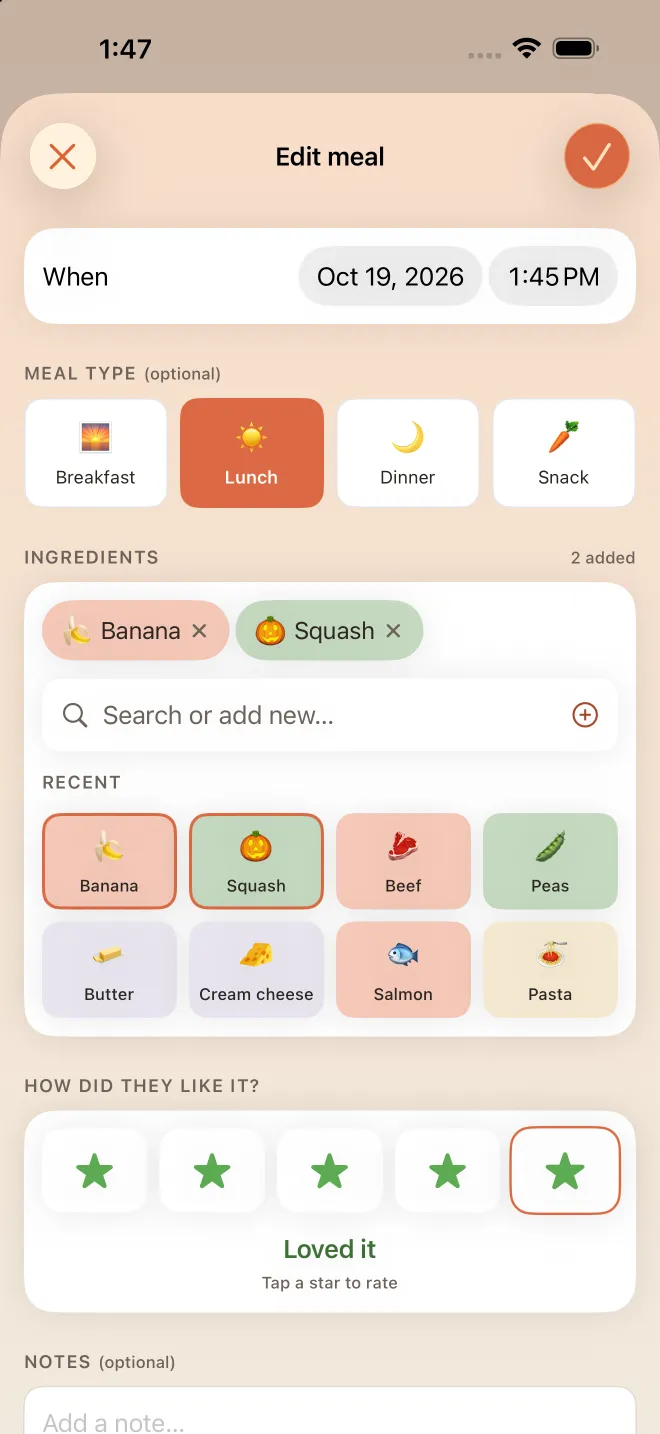
Every column on the printable has a place in the app, using the same 1–5 scales.
- Add the mealTap +, set the time and meal type, and pick the ingredients. New foods are tracked automatically.
- Rate how they liked itTap a star under How did they like it?, from Refused to Loved it.
- Note the amount and anything oddUse the meal's notes for "half a pancake" or "red cheeks after".
- Score sleep and poop laterOpen Sleep & poop from the meal card, or from the check-in AllerLog sends after a new food.
- Review weeklyOpen Ingredients to see each food's average and chart, or History for a calendar of good and bad days.
Frequently asked questions
How long should I keep a baby food diary?
At least through the first few months of solids, and until the common allergens are part of your baby's regular diet. Many parents keep going until around their baby's first birthday, or longer if they're keeping an eye on a particular food.
Do I need to write down every snack?
Write down anything new, any common allergen, and any meal that's followed by symptoms. Familiar snacks are optional, but the more complete the diary, the easier it is to rule foods in or out later.
Is a food diary useful for the doctor?
Yes. A doctor or allergist investigating a possible food allergy or intolerance will usually ask what your baby ate, when, and what happened afterwards. A diary answers those questions far better than memory, and makes it easier to plan any next steps.
Sources & further reading
- Food allergies in babies and young children — NHS
- Food allergy: diagnosis — NHS
- Your baby's first solid foods — NHS
- Starting solid foods — American Academy of Pediatrics, HealthyChildren.org
AllerLog is a tracking and journaling tool that helps you and your pediatrician spot patterns. It is not a medical device and does not diagnose, treat or prevent any condition. This page is general information, not medical advice: always talk to a qualified healthcare professional about your child's diet, allergies and health. If your child has trouble breathing, swelling of the face or tongue, widespread hives, repeated vomiting or becomes floppy or pale after eating, call your local emergency number straight away.