
Reactions
Baby food reaction log: what to write down when you suspect a reaction
When something happens after a meal, the details fade fast. These are the ten things your pediatrician or allergist will ask about, in a log you can print or keep on your phone.
Quick answer
In a baby food reaction log, write down what your baby ate (every ingredient, how much and how it was cooked), what time they ate it, when the first symptom started, exactly what you saw and where on the body, how long it lasted, what you did, and whether they'd had that food before. Add a photo if you can. These are the details a doctor will ask for (the American Academy of Pediatrics lists the suspected food, how long after eating symptoms started, how severe they were, how long they lasted and what treatment was needed), and they're the first to fade from memory.
First: is this an emergency?
Call your local emergency number (911, 999 or 000) if your baby has difficulty breathing, wheezing or noisy breathing, swelling of the lips, tongue or throat, widespread hives with vomiting, or becomes pale, floppy or unresponsive. If you've been given an adrenaline (epinephrine) auto-injector, use it as instructed. Write the log afterwards.
The 10 things to write down
- The food. Every ingredient in the meal, the brand if it was packaged, and how it was prepared (raw, baked, scrambled, a smear of peanut butter).
- How much. A taste, a few spoons, a full portion.
- When they ate it. The time the meal started.
- When the first symptom appeared. "10 minutes after", "about 3 hours later". Timing helps a doctor tell different types of reaction apart.
- What you saw. Be specific: raised welts or flat redness? Around the mouth only, or on the body? One vomit or repeated vomiting? Coughing, sneezing, swelling?
- How long it lasted and whether it spread or faded.
- What you did. Wiped the face, gave an antihistamine your doctor had recommended, called a nurse line, went to the emergency room.
- Photos of any rash or swelling, with the time.
- History with this food. First time? Had it before without problems? Reacted before?
- Anything else going on. A cold, a fever, teething, a new soap or sunscreen, a recent vaccine.
Immediate or delayed? Why the timing matters
Reactions that start within minutes to a couple of hours of eating, such as hives, swelling or vomiting, are typical of immediate (IgE-mediated) food allergy. Others are delayed by several hours or even days and tend to show up in the gut, the skin or sleep: diarrhea, mucus or blood in the stool, reflux, eczema flares. A distinct, serious delayed reaction called FPIES causes repeated, often severe vomiting a few hours after a trigger food. Your log's timings help a doctor work out which of these is most likely. For more detail, see how long after eating a reaction can happen.
Printable food reaction log
Print a few copies and keep them with your baby's things. One page per reaction.
| Date | |
|---|---|
| Food(s) & ingredients | |
| Brand / how prepared | |
| How much was eaten | |
| Time eaten | |
| Time first symptom started | |
| Symptoms (what & where) | |
| How long it lasted | |
| What we did | |
| Photo taken? | |
| Eaten this food before? | |
| Other factors (illness, teething…) | |
| Next poop & sleep | |
| Doctor contacted / advice |
After a reaction: what to do next
- Pause that food until you've spoken to your pediatrician, unless the reaction was clearly minor irritation and your doctor has told you it's fine.
- Call your pediatrician the same day for anything beyond mild, short-lived redness. Bring your log and photos.
- Keep the rest of the diet going. Don't cut out lots of foods at once "just in case". Unnecessary restriction makes it harder to keep allergens in the diet and can affect nutrition.
- Keep logging. Ongoing meal, sleep and poop records help your doctor decide on next steps, such as allergy testing or a supervised food challenge.
Keep your reaction log in AllerLog
Because the meal is already logged with its time and ingredients, half of the reaction log is done before anything happens.
- Open the mealFind it on Today or in History. The time and ingredients are already there.
- Write what happenedEdit the meal and add the symptoms, timing and what you did to its notes.
- Score the aftermathSet the sleep and poop scores for that meal once you know how the night and the next diaper went.
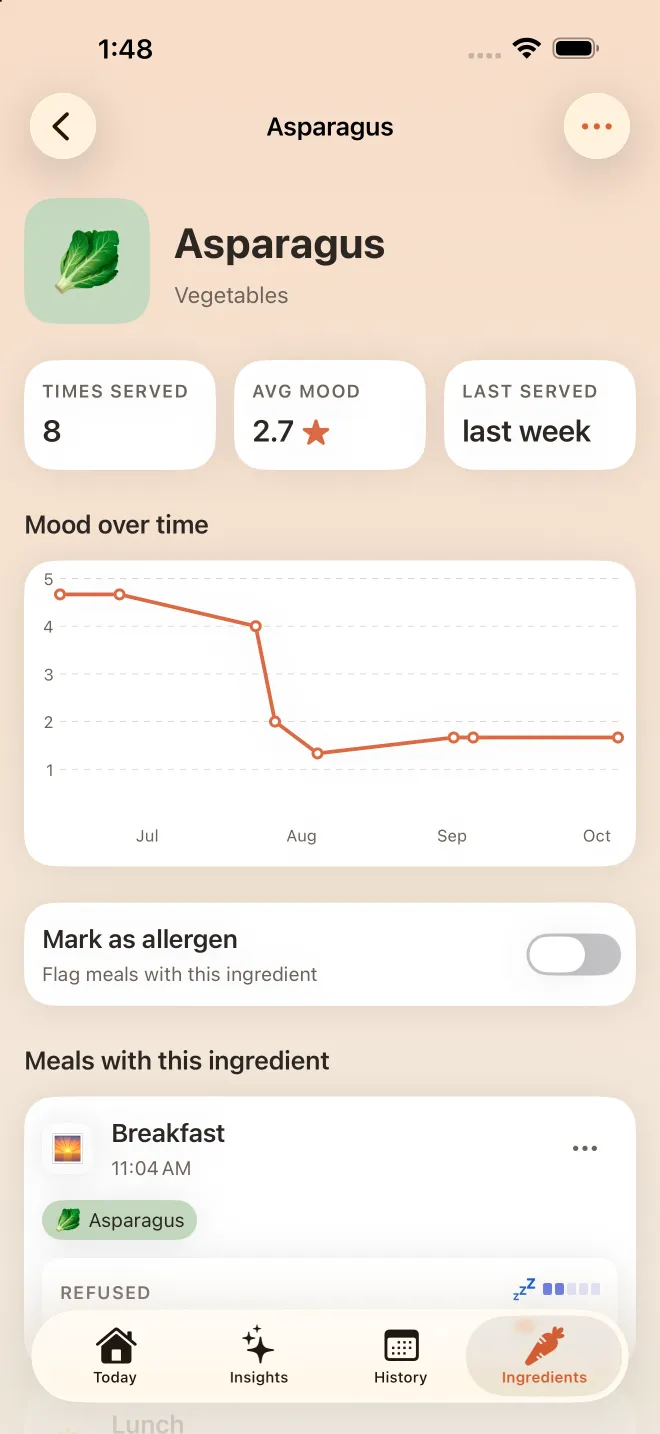
- Flag the suspectOpen the ingredient and switch on Mark as allergen. It joins the Allergens filter, and any future meal containing it gets a check-in an hour later.
- Take photos with your cameraAllerLog doesn't store meal photos, so keep them in your Photos app and note the time in the meal.
Frequently asked questions
Should I give the food again to see if it happens twice?
Not without talking to your pediatrician first if the reaction involved hives, swelling, vomiting or breathing symptoms. Re-testing a suspected allergen at home can be risky. Your doctor may recommend testing or a supervised food challenge instead.
Should I take photos of a reaction?
Yes, if you can do it safely. Rashes and hives often fade by the time you see a doctor, so a clear photo with the time noted is very helpful. Never delay emergency care to take one.
Do I need to log mild reactions?
Yes. A small rash or a single loose stool may mean nothing, but if it happens again after the same food, your earlier note is what turns it into a pattern.
Sources & further reading
- Recognizing and treating reaction symptoms — Food Allergy Research & Education (FARE)
- Food allergies in babies and young children — NHS
- Anaphylaxis — NHS
- Food allergies in children — American Academy of Pediatrics, HealthyChildren.org
- Food allergy: diagnosis — NHS
AllerLog is a tracking and journaling tool that helps you and your pediatrician spot patterns. It is not a medical device and does not diagnose, treat or prevent any condition. This page is general information, not medical advice: always talk to a qualified healthcare professional about your child's diet, allergies and health. If your child has trouble breathing, swelling of the face or tongue, widespread hives, repeated vomiting or becomes floppy or pale after eating, call your local emergency number straight away.