Allergens
Allergen introduction tracker: introduce the top 9 allergens and keep them going
Introducing allergens is a two-part job: getting each one in, then keeping it in. This tracker covers both, with a printable chart and the timing guidelines behind it.
Quick answer
An allergen introduction tracker records two things for each of the top 9 allergens: the first few servings (date, amount, any reaction) and whether it's still in the diet each week. Introduce the allergens one at a time, starting soon after solids begin, build each up to a normal serving, then keep it on the menu at least once a week, as ASCIA recommends. Use the free printable below, or let an app keep the record.
Current guidance has changed a lot from the "wait and see" advice many of us grew up with. Health bodies including the American Academy of Pediatrics, the NHS and ASCIA now agree that there's no benefit in delaying the common allergens, and that introducing them in the first year, then keeping them in the diet, is the best approach for most babies. The hard part is keeping track of nine foods over months. That's what this tracker is for.
The top 9 allergens
In the US, the FDA recognizes nine major food allergens:
| Allergen | Safe first form for babies |
|---|---|
| Milk | Plain full-fat yogurt, cheese, or milk in cooking (not as a main drink before 12 months) |
| Egg | Well-cooked egg: mashed hard-boiled, scrambled, omelette strips |
| Peanut | Smooth peanut butter thinned with water or milk, or peanut powder; never whole nuts |
| Tree nuts | Smooth nut butters or finely ground cashew, almond, walnut, hazelnut |
| Wheat | Toast fingers, soft pasta, wheat cereal |
| Soy | Tofu, soy yogurt |
| Sesame | Tahini, hummus |
| Fish | Flaked salmon, cod or other low-mercury fish, bones removed |
| Shellfish | Well-cooked shrimp or crab, finely chopped |
Outside the US, lists differ slightly. The NHS, for example, also includes gluten-containing grains such as barley and rye, beans, lentils and peas, celery and mustard.
When to start, and in what order
- Start once solids are underway, usually around 6 months and not before 4 months. ASCIA advises well-cooked egg and peanut soon after your baby starts solids.
- One at a time. Introduce one new allergen at a time, so a reaction has one obvious suspect. The AAP suggests one new food every 3 to 5 days; read more about the 3-day rule.
- Any order is fine for most babies, though egg and peanut usually come first. See what order to introduce allergens for a sample sequence.
- Check first if your baby is higher-risk. For babies with severe eczema, egg allergy or both, the US NIAID guidelines suggest peanut as early as 4 to 6 months but with allergy testing strongly considered first, so talk to your pediatrician before introducing it.
How to introduce each one
- Offer a small amount in a safe form, earlier in the day.
- Watch closely for about 2 hours, when most immediate reactions happen.
- If all is well, offer it again over the next few days, building up the amount. ASCIA suggests doubling it each time up to a normal serve for your baby's age.
- Once your baby eats a normal serving without symptoms, mark it as introduced and move to the next allergen.
- Keep every introduced allergen in the diet at least once a week.
Printable allergen introduction tracker
Write the date of each of the first three servings, then tick each week the allergen was offered.
| Allergen | 1st try | 2nd | 3rd | Wk 1 | Wk 2 | Wk 3 | Wk 4 | Wk 5 | Wk 6 | Wk 7 | Wk 8 | Notes |
|---|---|---|---|---|---|---|---|---|---|---|---|---|
| Egg | ||||||||||||
| Peanut | ||||||||||||
| Milk | ||||||||||||
| Wheat | ||||||||||||
| Soy | ||||||||||||
| Sesame | ||||||||||||
| Fish | ||||||||||||
| Shellfish | ||||||||||||
| Cashew | ||||||||||||
| Almond | ||||||||||||
| Walnut | ||||||||||||
| Hazelnut |
Tip: print in landscape. Tree nuts are listed separately because each one is a different allergen.
If there's a reaction
Stop the food. Call your local emergency number for breathing difficulty, wheezing, swelling of the face or tongue, or a pale, floppy baby. For milder symptoms, such as a few hives or a single vomit, contact your pediatrician before offering that food again. ASCIA advises carrying on with the other allergens, with medical advice. Our reaction log lists what to write down.
Use AllerLog as your allergen tracker
AllerLog was built around this routine: flag the allergen, log the serving, check in afterwards, and keep it going.
- Allergens are flagged for youPeanut, egg, milk and dairy, fish, shrimp and tree nuts are already marked as allergens among the 158 built-in foods, along with wheat, soy and sesame foods like bread, tofu and tahini.
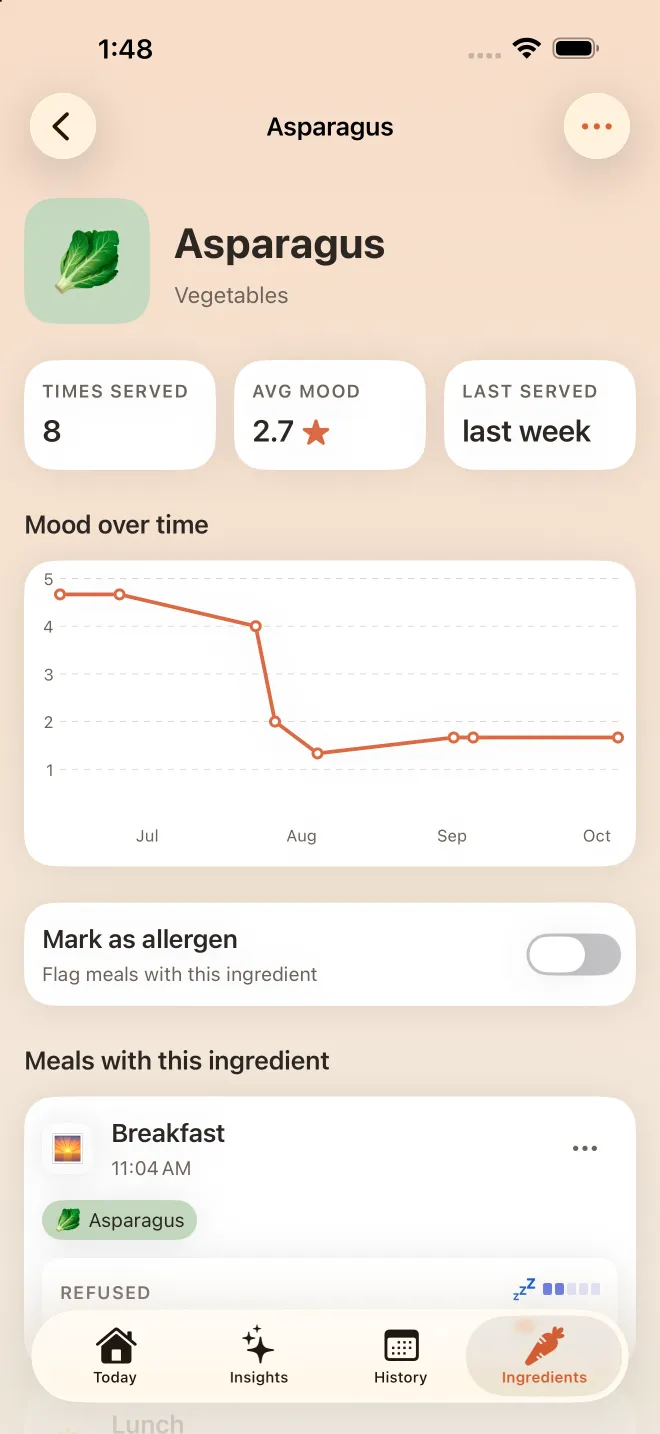
- Flag anything elseOpen any ingredient and switch on Mark as allergen. Custom foods can be flagged too.
- Get a check-in after every servingAn hour after a meal with a flagged allergen, AllerLog asks how it went. Brand-new foods get a check-in after 3 hours. Both delays are adjustable.
- See them all in one placeThe Allergens filter in Ingredients lists every flagged food. Open one to see how many times it's been served and when it was last served.
- Catch a pattern earlyEach allergen's chart includes the mood, sleep and poop scores of every meal it was in, so a slow, delayed reaction has somewhere to show up.
Frequently asked questions
When should I start introducing allergens?
Soon after your baby starts solids, which for most babies is around 6 months and not before 4 months. ASCIA advises introducing the common allergens in the first year (by 12 months), with egg and peanut soon after solids begin.
Is there an allergen tracker app?
Yes. AllerLog works as an allergen tracker: common allergens are flagged in its ingredient library, you can flag any other food, each serving triggers a check-in an hour later, and an Allergens filter keeps them all in one place.
Do I need to keep giving allergens after they're introduced?
Yes. ASCIA recommends including each tolerated allergen at least once a week, and the NHS advises making them part of your baby's usual diet to minimise the risk of allergy.
Sources & further reading
- How to introduce solid foods to babies for allergy prevention — ASCIA
- Food allergies in babies and young children — NHS
- When to introduce egg, peanut butter and other common food allergens — American Academy of Pediatrics, HealthyChildren.org
- Addendum guidelines for the prevention of peanut allergy in the United States (NIAID-sponsored expert panel) — Journal of Allergy and Clinical Immunology, 2017
- Starting solid foods — American Academy of Pediatrics, HealthyChildren.org
- Food allergies: the major food allergens — U.S. Food & Drug Administration
AllerLog is a tracking and journaling tool that helps you and your pediatrician spot patterns. It is not a medical device and does not diagnose, treat or prevent any condition. This page is general information, not medical advice: always talk to a qualified healthcare professional about your child's diet, allergies and health. If your child has trouble breathing, swelling of the face or tongue, widespread hives, repeated vomiting or becomes floppy or pale after eating, call your local emergency number straight away.