Starting solids
Starting solids tracker: what to track in the first months
The first months of solids bring a new food almost every day. Here's what's worth keeping track of, a sample first month, and how to do it without a notebook.
Quick answer
When your baby starts solids, track five things: which foods they've tried (and when), the common allergens and how often they're getting them, how they liked each food, any reactions, and the sleep and poop changes that follow. A tracker that does this automatically means you can focus on the meal, not the notebook.
Starting solids is one of the busiest stretches of the first year. In a few months your baby goes from their first spoonful to eating a version of family meals, and along the way meets dozens of new foods, all of the common allergens and a steady climb in textures. It's a lot to keep in your head, and the details matter: which foods have been introduced, which ones are still to come, and which one was on the menu before that unsettled night.
Is your baby ready?
Most guidance, including from the American Academy of Pediatrics, the NHS and the US Dietary Guidelines, suggests starting solids at around 6 months and not before 4 months. Every baby is different, so look for the signs rather than the date:
- They can hold their head steady and sit up with support.
- They're interested in food: watching you eat, reaching for your plate.
- They open their mouth when food comes their way.
- They can move food to the back of the mouth and swallow it, rather than pushing it straight back out.
If your baby was born early or has a medical condition, ask your pediatrician when to start.
The five things worth tracking
1. Every first taste
Knowing what's been tried, and when, is the backbone of everything else. It tells you which foods are "new" (and deserve a closer eye) and which are already familiar. A list like our 100 first foods checklist also helps you keep variety up.
2. The common allergens
Peanut, egg, cow's milk, wheat, soy, sesame, fish, shellfish and tree nuts are the foods most likely to cause allergic reactions. Current guidance is to introduce them in the first year rather than delay them, one at a time, and then keep them in the diet regularly. That second part is easy to forget without a record.
3. How they liked it
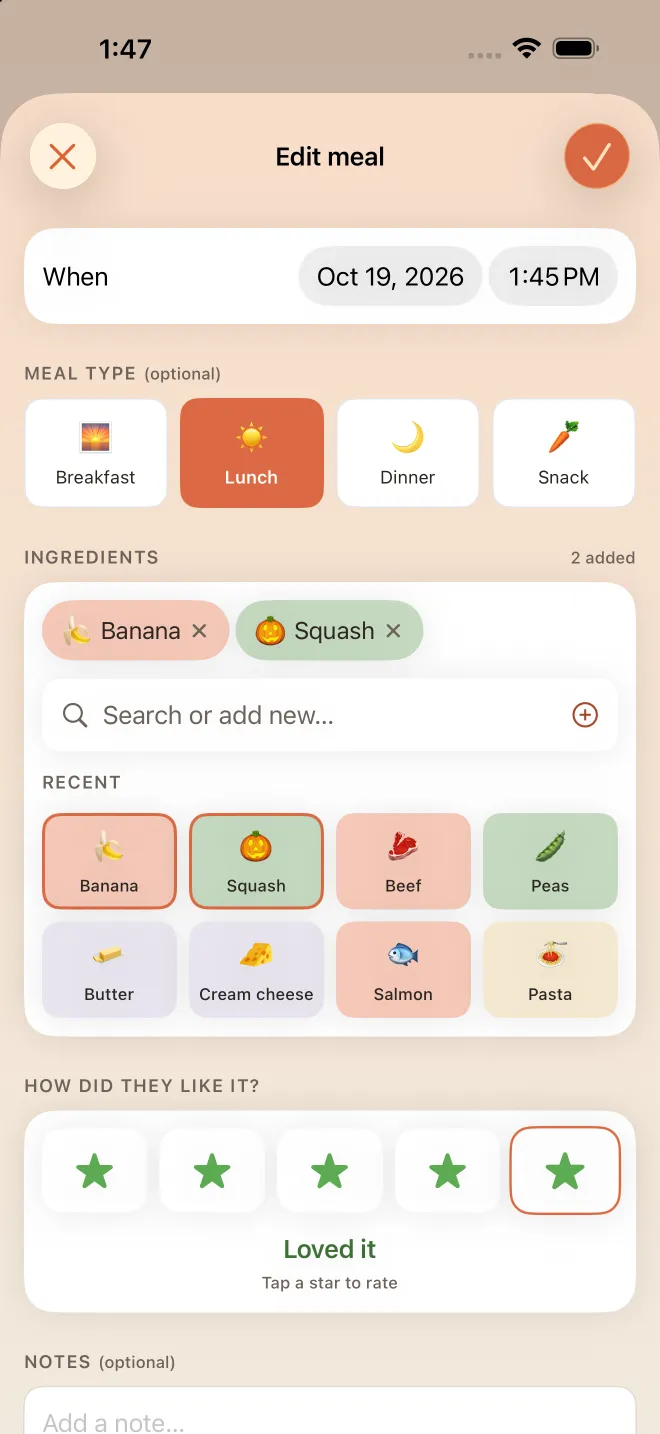
A food refused today might be loved next month: babies often need many tries before they accept a new taste. Rating each meal helps you keep offering foods they turned down instead of quietly dropping them.
4. Reactions
Most first foods go without a hitch. When something does happen, such as a rash, vomiting or swelling, write down the food, the amount and the time, and use our reaction log to capture the details your pediatrician will ask for.
5. Sleep and poop
These are the quiet signals. Poop changes a lot once solids start, and that's mostly normal, but a food that keeps lining up with a rough night or an off diaper is worth noticing. Scoring both after meals turns those hunches into something you can see.
A sample first month of solids
This is one possible shape, not a rule. Your pediatrician may suggest a different pace, especially if your baby has eczema or an existing allergy.
| Week | What it might look like | What to track |
|---|---|---|
| 1 | One meal a day. Smooth or very soft single foods: sweet potato, avocado, banana, oatmeal. | Each first taste; how they liked it |
| 2 | Keep going with new vegetables and fruits; add a first allergen such as well-cooked egg. | Allergen date and amount; next 2 hours, next diaper, next night |
| 3 | Thicker textures or soft finger foods; a second allergen such as thinned smooth peanut butter. | Allergen; keep the first allergen going |
| 4 | Two meals a day; new allergens such as dairy (yogurt), wheat or fish, one at a time. | Which allergens are now regular; sleep and poop trends |
Common tracking mistakes
- Only logging new foods. If you don't log familiar meals too, you can't tell whether a bad night followed the new food or the usual one.
- Forgetting hidden ingredients. Butter, milk in scrambled egg, wheat in pasta, egg in pancakes: list them all.
- Introducing several allergens at once. If there's a reaction, you won't know which one caused it.
- Dropping allergens after the first taste. An allergen your baby had once in month one and never again isn't really "introduced".
- Judging a food on one meal. Look for repeats before drawing conclusions.
Track starting solids in AllerLog
AllerLog was made for this stretch: quick enough for one-handed logging, with the reminders and charts a notebook can't do.
- Log each meal in secondsPick ingredients from 158 built-in foods, sorted into categories like fruits, vegetables, grains, proteins and dairy, or add your own.
- Let it spot first tastesWhen a food is new, AllerLog sends a check-in 3 hours later asking how it went. The Today screen counts new foods this week.
- See what's left to tryIn Ingredients, filter by Not tried to see foods your baby hasn't had yet, or by Allergens to check the common ones.
- Score sleep and poopTwo 1–5 scores after meals. They feed each ingredient's 12-month chart.
- Watch the patternsFavorites fills itself with foods averaging 4 or more. With Premium, Insights also flag foods that keep scoring low.
Frequently asked questions
When should my baby start solids?
Most guidance, including from the American Academy of Pediatrics and the NHS, points to around 6 months, and not before 4 months. More important than the date are the readiness signs: good head control, sitting with support, interest in food, and being able to move food to the back of the mouth and swallow it.
How many new foods a week should I introduce?
There's no fixed number. Many families introduce a few new foods a week, giving each common allergen its own few days so any reaction is easy to trace. Familiar, low-risk foods can be combined freely in between.
Should my baby's poop change after starting solids?
Yes. It usually becomes thicker, darker and smellier, and colors can change with the food. Bits of undigested food are common. Ask your pediatrician about blood, black or white stools, or diarrhea that doesn't settle.
Sources & further reading
- Starting solid foods — American Academy of Pediatrics, HealthyChildren.org
- Your baby's first solid foods — NHS
- How to introduce solid foods to babies for allergy prevention — Australasian Society of Clinical Immunology and Allergy (ASCIA)
- Dietary Guidelines for Americans 2020–2025 — USDA & HHS
AllerLog is a tracking and journaling tool that helps you and your pediatrician spot patterns. It is not a medical device and does not diagnose, treat or prevent any condition. This page is general information, not medical advice: always talk to a qualified healthcare professional about your child's diet, allergies and health. If your child has trouble breathing, swelling of the face or tongue, widespread hives, repeated vomiting or becomes floppy or pale after eating, call your local emergency number straight away.