Checklist
100 first foods checklist: a free printable and how to track it
One hundred foods before (or around) the first birthday is a fun goal that keeps variety high. Here's the list, grouped and printable, with the allergens marked.
Quick answer
A 100 first foods checklist is a list of foods to offer your baby in their first year of solids, ticked off as they try each one. The list below has 100 foods in eight groups: fruits, vegetables, grains, meat and fish, beans and lentils, nuts and seeds, dairy, and herbs and spices. The common allergens are marked A so you can introduce them one at a time.
The "100 foods before 1" idea is simple: the more tastes and textures babies meet early on, the more chances they get to accept them. It's a goal, not a rule. Some babies tick off 100 by nine months; others take well into their second year, and both are fine. What matters is variety, a steady stream of second and third tries for the foods that were refused, and getting the common allergens into the diet.
How to use the checklist
- Tick a food the first time it's offered, even if it mostly ends up on the floor.
- Introduce allergens one at a time, in a small amount, and watch for a couple of hours afterwards. Once they're going well, keep offering them regularly.
- Serve everything in a safe form for your baby's age: soft, mashed or in finger-length strips, with choking hazards cut down or avoided.
- Re-offer refused foods. A "no" on day one isn't a final answer.
Printable 100 first foods checklist
A = common allergen: introduce one at a time and talk to your pediatrician first if your baby has severe eczema or a known food allergy.
Fruits (22)
- Apple
- Apricot
- Avocado
- Banana
- Blackberries
- Blueberries
- Cantaloupe
- Cherries (pitted)
- Dates
- Grapes (quartered)
- Kiwi
- Mango
- Orange
- Papaya
- Peach
- Pear
- Pineapple
- Plum
- Prunes
- Raspberries
- Strawberries
- Watermelon
Vegetables (24)
- Asparagus
- Beets
- Bell pepper
- Broccoli
- Butternut squash
- Cabbage
- Carrot
- Cauliflower
- Corn
- Cucumber
- Eggplant
- Green beans
- Kale
- Leek
- Mushrooms
- Onion
- Parsnip
- Peas
- Potato
- Pumpkin
- Spinach
- Sweet potato
- Tomato
- Zucchini
Grains & starches (12)
- Barley
- Bread A
- Buckwheat
- Couscous A
- Millet
- Oats
- Pasta A
- Plantain
- Polenta
- Quinoa
- Rice
- Semolina A
Meat, fish & eggs (14)
- Beef
- Chicken
- Cod A
- Crab A
- Egg A
- Hake A
- Lamb
- Mackerel A
- Pork
- Salmon A
- Sardines A
- Shrimp A
- Tuna (canned light) A
- Turkey
Beans, lentils & tofu (8)
- Black beans
- Cannellini beans
- Chickpeas
- Edamame (mashed) A
- Kidney beans
- Lentils
- Mung beans
- Tofu A
Nuts & seeds, as smooth butters or finely ground (8)
- Almond A
- Cashew A
- Chia seeds
- Ground flaxseed
- Hazelnut A
- Peanut A
- Sesame (tahini) A
- Walnut A
Dairy (6)
- Butter A
- Cheddar cheese A
- Cottage cheese A
- Cow's milk in cooking A
- Plain yogurt A
- Ricotta A
Herbs & spices (6)
- Basil
- Cinnamon
- Cumin
- Garlic
- Ginger
- Turmeric
Serving these foods safely
Every food on the list can be served safely to most babies from around 6 months, but the form matters:
- Soft enough to squash between your thumb and finger, or mashed, for the first months.
- Round foods such as grapes, cherry tomatoes and blueberries: quarter them lengthwise or flatten them.
- Nuts and peanuts: only as smooth butters (thinned) or finely ground. Never whole or chopped before age 5.
- Hard vegetables and apple: cook until soft, or grate raw apple finely.
- Fish: check carefully for bones, and choose lower-mercury fish such as salmon, cod, sardines and canned light tuna.
- Eggs and shellfish: cook thoroughly.
Not on the list, for good reason
Honey (not before 12 months, because of the risk of infant botulism), whole nuts, popcorn, added salt and sugar, cow's milk as a main drink before 12 months, unpasteurized cheese and milk, raw or lightly cooked shellfish, and shark, swordfish or marlin.
Track your 100 first foods in AllerLog
The printable is great for the fridge. AllerLog does the ticking-off for you.
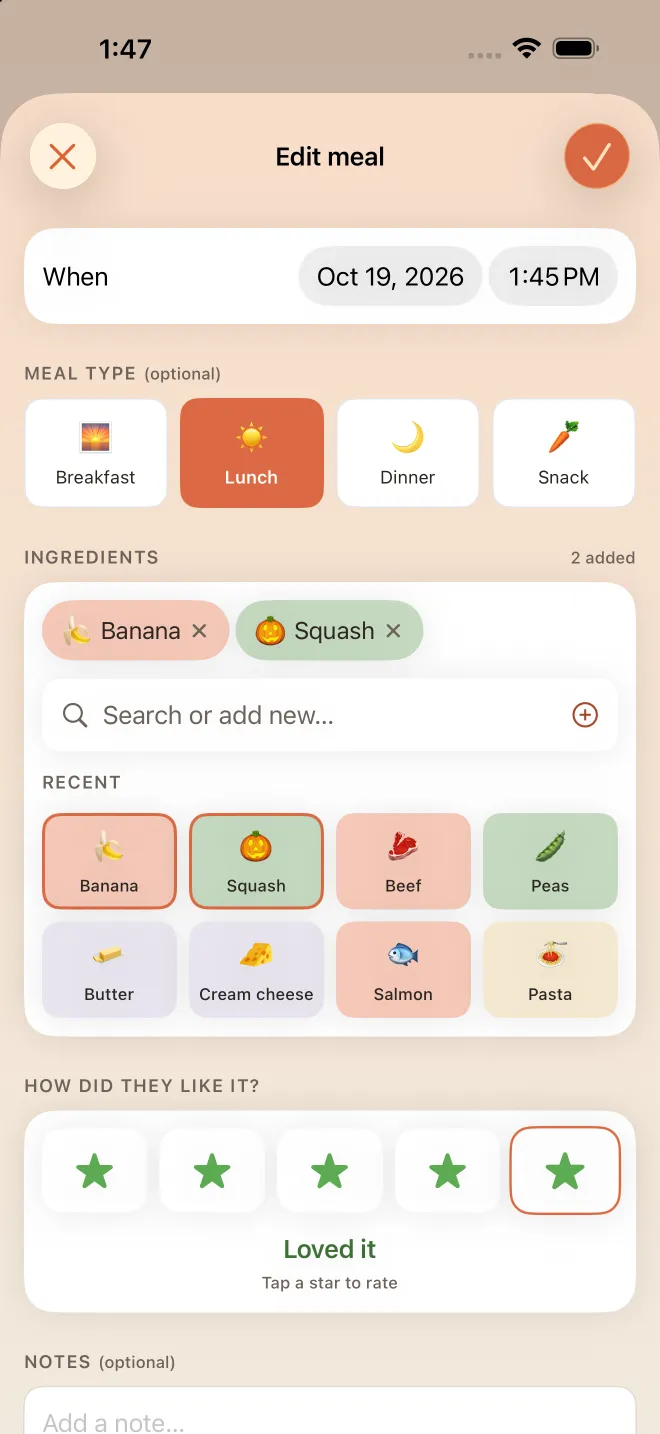
- Log meals as usualAlmost every food above is already among AllerLog's 158 built-in ingredients. Add anything missing, like crab or chia seeds, as your own ingredient.
- See what's leftIn Ingredients, the Not tried filter lists the foods your baby hasn't had yet.
- Count this week's firstsThe Today screen shows how many new foods your baby tried this week. With Premium, Newly introduced lists the foods from the last 7 days.
- Watch first tastesA check-in arrives 3 hours after any brand-new food, and 1 hour after a flagged allergen.
- Keep favorites in rotationThe Favorites filter shows the foods averaging 4 or more, perfect for days when you need a sure thing.
Frequently asked questions
Does my baby really need 100 foods before age 1?
No. The number is a motivating goal, not a medical target. What matters is offering a wide variety of tastes and textures, including the common allergens, and keeping foods your baby has accepted in regular rotation.
Does a food count if my baby only licked it?
For the checklist, many parents count any first taste. For allergens it's worth offering a proper serving later on, and then keeping that food in the diet regularly.
Which foods should babies not have in the first year?
Honey (until 12 months), whole nuts and other choking hazards, added salt and sugar, cow's milk as a main drink (it can be used in cooking), unpasteurized dairy, raw or lightly cooked shellfish, and high-mercury fish such as shark, swordfish and marlin.
Sources & further reading
- Foods to avoid giving babies and young children — NHS
- Your baby's first solid foods — NHS
- Starting solid foods — American Academy of Pediatrics, HealthyChildren.org
- Food allergies: the major food allergens — U.S. Food & Drug Administration
AllerLog is a tracking and journaling tool that helps you and your pediatrician spot patterns. It is not a medical device and does not diagnose, treat or prevent any condition. This page is general information, not medical advice: always talk to a qualified healthcare professional about your child's diet, allergies and health. If your child has trouble breathing, swelling of the face or tongue, widespread hives, repeated vomiting or becomes floppy or pale after eating, call your local emergency number straight away.