Poop & digestion
How long does it take food to show up in a baby's poop?
You served carrots at lunch. When should you expect orange in the diaper, and how long should you watch for a tummy reaction? Here's what's known, and what isn't.
Quick answer
Usually within a day or two, though it varies from baby to baby and meal to meal. There's surprisingly little research in babies: food moves through newborns quickly, and one study of 1 to 4 year olds measured an average transit time of about 33 hours. For tracking, that means watching the next poop or two after a new food, not just the first diaper after the meal.
Few parents expected to become this interested in digestion times. But once solids start and the carrots reappear in technicolor, it's a fair question, and it matters for something more important than curiosity: knowing how long to watch for a food's effects.
What the research says
"Gut transit time" is how long food takes to travel from mouth to diaper. It's hard to measure in babies, so the research is thin:
- Newborns move food through fast. Reviews put early newborn transit at around 8 hours, which fits the frequent poops of the first weeks.
- Young children are slower. A classic study of children aged 1 to 4 measured an average intestinal transit time of about 33 hours.
- Babies of 6 to 12 months, the age most babies start solids, sit somewhere in between, and there's little direct measurement.
In practice, many parents notice a new food's color or texture in the diaper the same day or the next, and sometimes a day after that.
Why it varies
- Fiber generally speeds things up; very low-fiber or very dairy-heavy days can slow them down.
- Fluids: less water and milk can mean slower, harder poops.
- Constipation or illness can slow transit or speed it up dramatically.
- The individual baby: some babies poop several times a day, others every couple of days, and both can be normal.
What this means for spotting a reaction
Changes in poop are one of the most common signs that a food doesn't agree, but they don't show up at the table. The NHS notes that most allergic reactions happen within minutes to 2 hours, while some, such as cow's milk allergy, can take up to 3 days. Put that together with transit time and the practical rule is:
- Watch closely for the first couple of hours after a new food.
- Score the next poop or two, even if it's the following day.
- Give each new allergen a few days before the next, so a delayed change still has one suspect. See the 3-day rule.
Match the diaper to the meal in AllerLog
- Log the meal when you serve itThe time and ingredients are saved straight away.
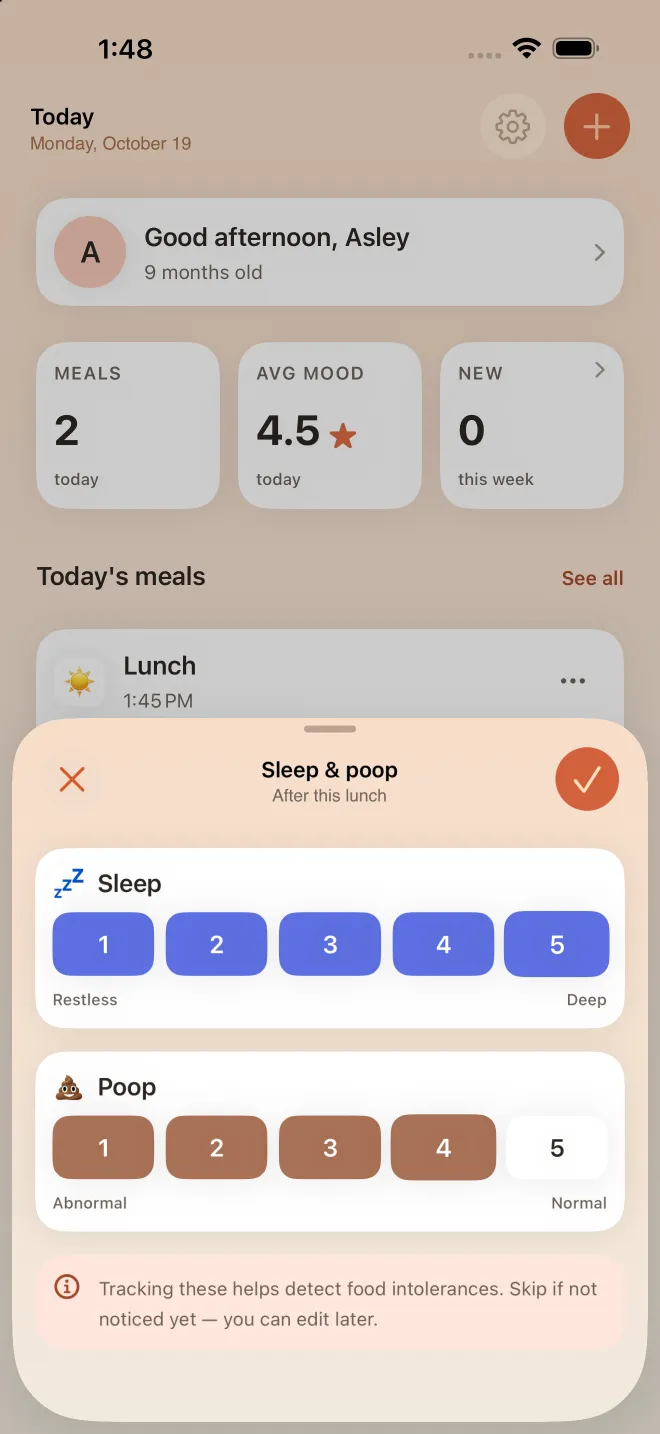
- Score the poop when it arrivesOpen that meal's Sleep & poop sheet later, even the next day, and add the score. Nothing has to be filled in at the table.
- Let the check-in remind youA check-in arrives 3 hours after a brand-new food. You can stretch the delay, up to 7 days, in Settings.
- Read the pattern over weeksEach ingredient's chart includes the poop scores of the meals it was in.
Frequently asked questions
Why does food come out looking the same as it went in?
Foods with tough skins or lots of fiber, like corn, peas, beans and tomato skins, often pass through partly undigested while babies are still learning to chew. It's usually normal.
Does breastfeeding or formula change how fast food moves through?
There's little research on transit time once solids start, whatever the milk. What matters most for tracking is learning your own baby's normal and noticing changes from it.
If a reaction is delayed, how will I know which food caused it?
Space out new foods, especially allergens, by a few days, and keep a log of every meal with its ingredients. Then a delayed change in poop or sleep still has a short list of suspects.
Sources & further reading
- The bowel habit of young children (Weaver & Steiner) — Archives of Disease in Childhood, 1984
- Functional constipation in children: what physicians should know (review) — World Journal of Gastroenterology, 2023
- Starting solid foods — American Academy of Pediatrics, HealthyChildren.org
- Food allergies in babies and young children — NHS
AllerLog is a tracking and journaling tool that helps you and your pediatrician spot patterns. It is not a medical device and does not diagnose, treat or prevent any condition. This page is general information, not medical advice: always talk to a qualified healthcare professional about your child's diet, allergies and health. If your child has trouble breathing, swelling of the face or tongue, widespread hives, repeated vomiting or becomes floppy or pale after eating, call your local emergency number straight away.