
Doctor visits
Seeing a doctor about a possible food allergy? What to bring and what to ask
The appointment is short, and the history you give is one of the most important parts of it. Here's how to arrive prepared, so you leave with a plan instead of more questions.
When a doctor or allergist investigates a possible food allergy, the first thing they'll want is the story: what your baby ate, when, what happened, and how often. Tests can help, but they're interpreted against that history. The better your record, the faster and more accurate the next steps tend to be.
Before the appointment: gather the record
- The reaction itself. What was eaten (every ingredient, how much, how it was prepared), the time of the meal, when symptoms started, what they looked like and how long they lasted. Our reaction log lists the details to capture.
- Photos. Rashes and swelling often fade before the appointment. A clear, timed photo can be invaluable.
- The last few weeks of meals. Especially if symptoms are ongoing (tummy trouble, eczema, poor sleep) rather than a single event.
- Foods your baby already eats without problems, particularly the common allergens. This shapes what your doctor recommends next.
- Feeding details. Breastfed, formula (and which one) or both, and any recent changes.
- Family history of food allergy, eczema, asthma or hay fever.
- Anything else going on: recent illness, medicines, new skin products.
Questions worth asking
- Does this look like a food allergy, a food intolerance or something else?
- Is it an immediate or a delayed type of reaction?
- Should we avoid this food, and for how long?
- Do we need to avoid any related foods, or can those stay in the diet?
- Are tests needed, and what would the results change?
- Would a supervised food challenge help, now or later?
- Do we need an emergency action plan or an epinephrine auto-injector?
- How should we carry on introducing the other common allergens?
- When, and how, might we try this food again?
- Who should we call if it happens again?
What tests might come next
Depending on the type of reaction, your doctor may suggest:
- A skin prick test: a tiny amount of the food is placed on the skin, which is gently pricked. A raised bump suggests sensitivity.
- A blood test for allergy antibodies (specific IgE) to particular foods.
- An oral food challenge: small, increasing amounts of the food given under medical supervision. It's the most reliable way to confirm or rule out an allergy.
- An elimination and reintroduction trial, often used for delayed (non-IgE) allergies such as many cases of cow's milk allergy: the food is removed for a few weeks and then reintroduced to see whether symptoms return.
A positive test on its own doesn't always mean an allergy. As the American Academy of Pediatrics explains, it's possible to test positive but have no symptoms when eating the food, or to test negative and still have an allergy, which is exactly why your history matters so much. Allergy specialists also advise against "food intolerance" tests sold online or in shops, such as IgG blood tests, which aren't a reliable way to diagnose food allergy.
After the appointment
- Write down the plan while it's fresh: which foods to avoid, which to keep giving, and what to do if symptoms happen again.
- Share it with anyone else who feeds your baby.
- Keep logging. If your doctor has asked you to try an elimination diet or reintroduce a food, the log is how you'll both know whether it worked.
Use AllerLog as your record
- Find the reactionOpen History, switch to the calendar, and tap the day. The meal, its ingredients and your notes are all there.
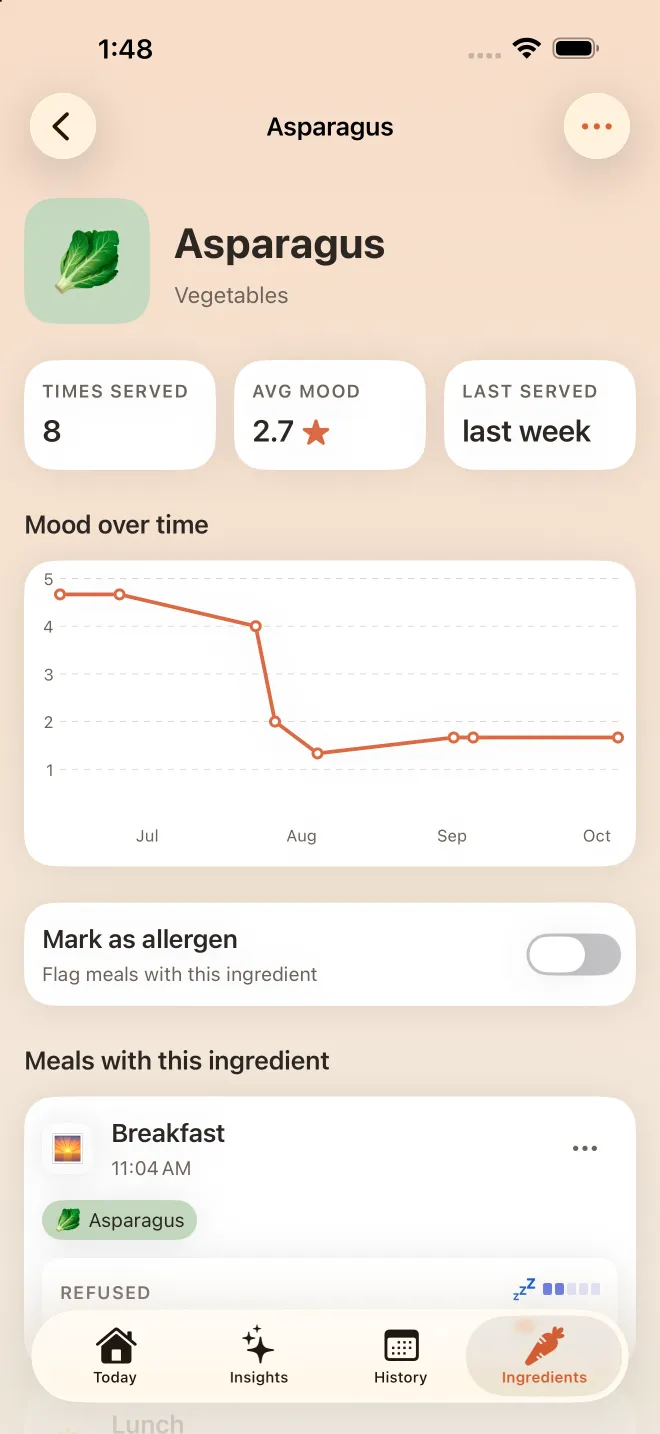
- Show the food's track recordOpen the ingredient to show how many times it's been served, its average score and a chart of every meal it was in.
- Show what's going wellThe Allergens filter lists the allergens your baby has had, and Favorites shows the foods that consistently go well.
- Keep logging after the visitIf your doctor suggests removing or reintroducing a food, keep scoring sleep and poop so the effect shows up in the chart.
Sources & further reading
- Food allergies in children — American Academy of Pediatrics, HealthyChildren.org
- Food allergy: diagnosis — NHS
- Food allergies in babies and young children — NHS
- Recognizing and treating reaction symptoms — Food Allergy Research & Education (FARE)
AllerLog is a tracking and journaling tool that helps you and your pediatrician spot patterns. It is not a medical device and does not diagnose, treat or prevent any condition. This page is general information, not medical advice: always talk to a qualified healthcare professional about your child's diet, allergies and health. If your child has trouble breathing, swelling of the face or tongue, widespread hives, repeated vomiting or becomes floppy or pale after eating, call your local emergency number straight away.