Allergens
How many times should a baby have an allergen before it counts as tolerated?
One taste of peanut and no reaction: does that mean you're done? Not quite. Here's how introduction usually works, and why the real job is keeping allergens on the menu.
Quick answer
There's no official number. A common approach, set out by Australia's allergy society (ASCIA), is to start with a small amount and, if there's no reaction, keep offering it, doubling the amount up to a normal serving for your baby's age. Once it's tolerated, keep it in the diet: ASCIA recommends at least once a week, and the NHS advises making it part of your baby's usual diet.
It's tempting to think of allergen introduction as a checklist: egg, done; peanut, done. But a single uneventful taste is the start, not the finish. What protects your baby best is getting each allergen up to a normal serving and then keeping it coming.
Introducing one allergen: a typical approach
- Start small. Offer a small amount of the allergen in a safe form, ideally earlier in the day, mixed into a food your baby already eats.
- Watch for a couple of hours. Most immediate reactions happen within minutes and up to 2 hours.
- Build up. If there's no reaction, offer it again over the next few days, increasing the amount. ASCIA suggests doubling the amount each time up to a normal serve for their age.
- Keep it going. Once your baby is eating a normal serving without symptoms, move on to the next allergen, but keep this one in the weekly menu.
If your baby has severe eczema or a known food allergy, ask your pediatrician before starting. They may want to plan introduction differently.
When does an allergen count as tolerated?
In practical terms, many families consider an allergen established once their baby has eaten a normal, age-appropriate serving on more than one occasion with no symptoms. A lick of peanut butter on a spoon doesn't tell you much. A proper serving, eaten happily a few times, does.
How often to keep giving allergens
This is the part that's easiest to forget. ASCIA recommends including each common allergen your baby tolerates at least once a week, because keeping these foods in the diet may reduce the chance of developing a food allergy. The NHS similarly advises that, once introduced and tolerated, these foods become part of your baby's usual diet.
A simple rotation makes it manageable:
| Day | Allergen in the menu |
|---|---|
| Monday | Egg: scrambled or in a muffin |
| Tuesday | Peanut: thinned peanut butter on toast |
| Wednesday | Dairy: yogurt or cheese |
| Thursday | Fish: salmon or cod |
| Friday | Sesame: hummus with tahini |
| Weekend | Wheat, soy and any tree nuts your baby has been introduced to |
What if there's a reaction partway through?
Stop that food and contact your pediatrician, or call emergency services for breathing difficulty, swelling of the face or tongue, or a floppy, pale baby. ASCIA advises that a reaction to one allergen isn't a reason to stop introducing the others, but get medical advice before trying the food that caused it again.
Track allergen exposures in AllerLog
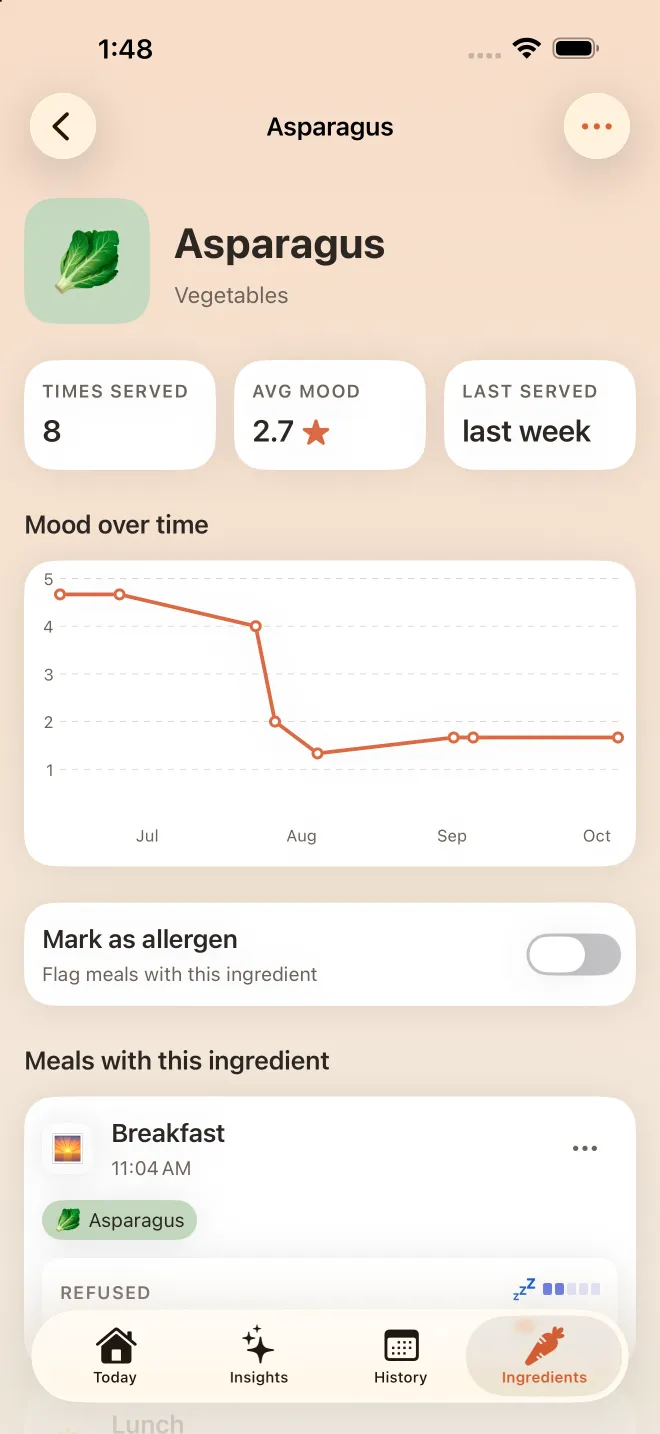
- Flag itCommon allergens like peanut, egg, dairy, fish and tree nuts are flagged already. For anything else, switch on Mark as allergen.
- Log every servingEach meal with the allergen counts toward its total, and triggers an allergen check-in an hour later.
- Check how it's goingOpen the allergen to see how many times it's been served, its average score and when it was last served.
- Spot the gapsThe Allergens filter brings all of them together, so one that's slipped off the menu is easy to notice.
Frequently asked questions
Does a reaction-free first taste mean my baby isn't allergic?
Not necessarily. A first taste is usually small, and some babies only react to a larger amount. That's why guidance such as ASCIA's suggests building up gradually to a normal serving and then keeping the food in the diet.
Can I mix allergens together once they're introduced?
Yes. Once each allergen has been introduced on its own and gone well, they can be combined in everyday meals, such as egg and wheat in pancakes or peanut butter on toast.
My baby hasn't had one of their allergens for a few weeks. Is that a problem?
Gaps happen, with illness, holidays or a picky phase. Usually you can simply start offering it again. If it's been a long break, or your baby has eczema or other food allergies, ask your pediatrician how to restart.
Sources & further reading
- How to introduce solid foods to babies for allergy prevention — ASCIA
- Food allergies in babies and young children — NHS
- Starting solid foods — American Academy of Pediatrics, HealthyChildren.org
AllerLog is a tracking and journaling tool that helps you and your pediatrician spot patterns. It is not a medical device and does not diagnose, treat or prevent any condition. This page is general information, not medical advice: always talk to a qualified healthcare professional about your child's diet, allergies and health. If your child has trouble breathing, swelling of the face or tongue, widespread hives, repeated vomiting or becomes floppy or pale after eating, call your local emergency number straight away.