Allergens
What order should you introduce allergens to your baby?
Egg first or peanut first? Fish before shellfish? The short answer is that the order matters less than the timing and the spacing. Here's how to plan it.
Quick answer
There's no single required order. Guidelines focus on timing and spacing: introduce the common allergens in the first year, starting soon after your baby begins solids, one at a time, and keep each one in the diet once it's tolerated. Many families start with egg and peanut, which ASCIA advises including soon after solids begin, then add dairy, wheat, soy, fish, sesame, tree nuts and shellfish. Babies with severe eczema or an egg allergy may need a doctor's plan first.
The list of foods to introduce can feel long: in the US, the FDA recognizes nine major food allergens (milk, eggs, fish, crustacean shellfish, tree nuts, peanuts, wheat, soybeans and sesame), and the NHS list adds a few more. The good news is that the order you choose matters far less than getting started on time and spacing them out.
Why egg and peanut often come first
Egg and peanut are the allergens with the clearest evidence that early introduction helps. ASCIA advises that well-cooked egg and smooth peanut butter (or finely ground peanut) be included in your baby's diet soon after they start solids, because delaying them has been shown to increase the chance of allergy. The NHS says the same: delaying peanut and hen's eggs beyond 6 to 12 months may increase the risk of developing an allergy to them.
The evidence for peanut is especially strong. In the landmark LEAP trial of high-risk babies, peanut allergy at age 5 was 13.7% among skin-test-negative babies who avoided peanut, against 1.9% among those who ate it regularly from infancy.
The American Academy of Pediatrics adds an important caveat: there's no benefit to delaying allergenic foods, but testing for peanut allergy is recommended for babies with severe eczema and/or egg allergy before peanut is introduced.
A sample order for the rest
This is one reasonable sequence, not a prescription. ASCIA suggests starting with the foods your family already eats, so swap the order around to suit your kitchen.
| Order | Allergen | Easy first form |
|---|---|---|
| 1 | Egg | Well-cooked, mashed hard-boiled or scrambled |
| 2 | Peanut | Smooth peanut butter thinned with water or milk, or peanut powder |
| 3 | Cow's milk | Plain full-fat yogurt, or milk in cooking |
| 4 | Wheat | Toast fingers, soft pasta, wheat cereal |
| 5 | Soy | Tofu, soy yogurt |
| 6 | Fish | Flaked salmon or cod, bones removed |
| 7 | Sesame | Tahini in hummus or mixed into purée |
| 8 | Tree nuts | Smooth nut butters or finely ground nuts, one nut at a time |
| 9 | Shellfish | Well-cooked shrimp, finely chopped |
Give each new allergen a few days on its own before the next, and keep the earlier ones going: ASCIA recommends offering each tolerated allergen at least once a week.
Tree nuts: one at a time
"Tree nuts" isn't one food. Cashew, walnut, almond, hazelnut, pistachio and the rest are separate allergens, and a baby can react to one but not another. Many families introduce them individually, starting with the ones the household eats most, always as smooth butters or finely ground, never whole.
Babies who need a plan first
Talk to your pediatrician before introducing allergens if your baby:
- has severe eczema, or eczema that started early and is hard to control
- has already reacted to a food, such as egg or cow's milk
- has a parent or sibling with a food allergy and you're unsure where to start
The US NIAID guidelines for peanut sort babies into three groups:
| Your baby | Peanut introduction (NIAID) |
|---|---|
| Severe eczema, egg allergy, or both | As early as 4 to 6 months, with allergy testing strongly considered first: talk to your pediatrician |
| Mild to moderate eczema | Around 6 months |
| No eczema or food allergy | Freely, alongside other solid foods |
Your doctor may recommend testing first, or introducing certain foods under medical supervision. ASCIA notes that babies with eczema or another food allergy should still have common allergens introduced in the first year, with the right plan.
Plan and track the order in AllerLog
- Start with the flagged foodsPeanut, egg, milk and dairy, fish, shrimp and tree nuts are flagged as allergens out of the box. Wheat, soy and sesame come in through foods like bread, tofu and tahini, which are flagged too.
- Log the first servingAn allergen check-in arrives an hour after any meal that contains a flagged food.
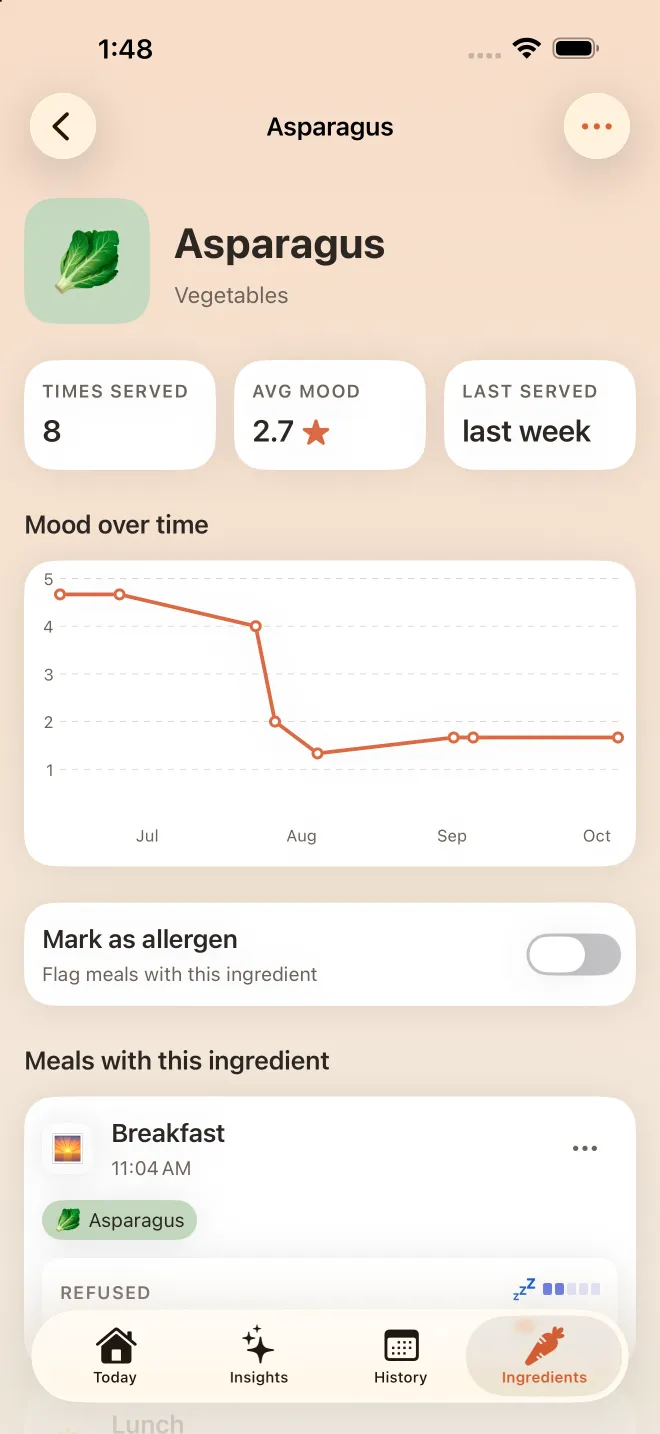
- See what's leftThe Not tried filter lists foods your baby hasn't had yet, including any allergens still to come, and Allergens lists every flagged food.
- Keep them weeklyEach allergen's page shows when it was last served, so you can rotate them through the week.
Frequently asked questions
Should I introduce egg or peanut first?
Either is fine for most babies. ASCIA advises including both well-cooked egg and peanut soon after starting solids, so many families do one and then the other within the first couple of weeks. If your baby has severe eczema or an egg allergy, ask your pediatrician before introducing peanut.
When should I start introducing allergens?
Once your baby has started solids, usually around 6 months and not before 4 months, and has had a few first foods. There's no benefit in delaying them, and the NHS notes that delaying peanut and egg beyond 6 to 12 months may increase the risk of allergy.
Do I need to introduce shellfish in the first year?
ASCIA includes shellfish among the common allergens to introduce in the first year, starting with foods your family already eats. Serve it well cooked and finely chopped or mashed.
Sources & further reading
- How to introduce solid foods to babies for allergy prevention — ASCIA
- Food allergies in babies and young children — NHS
- When to introduce egg, peanut butter and other common food allergens — American Academy of Pediatrics, HealthyChildren.org
- Addendum guidelines for the prevention of peanut allergy in the United States (NIAID-sponsored expert panel) — Journal of Allergy and Clinical Immunology, 2017
- Randomized trial of peanut consumption in infants at risk for peanut allergy (LEAP) — New England Journal of Medicine, 2015
- Early feeding guidance — British Society for Allergy & Clinical Immunology (BSACI)
- Food allergies: the major food allergens — U.S. Food & Drug Administration
AllerLog is a tracking and journaling tool that helps you and your pediatrician spot patterns. It is not a medical device and does not diagnose, treat or prevent any condition. This page is general information, not medical advice: always talk to a qualified healthcare professional about your child's diet, allergies and health. If your child has trouble breathing, swelling of the face or tongue, widespread hives, repeated vomiting or becomes floppy or pale after eating, call your local emergency number straight away.